

Today only: Your gift TRIPLE matched

Donate by midnight for 3X the impact. Can women artists count on you?    

National Museum of Women in the Arts

The Great Hunt I, from the series “Dirty Pretty”
Close up of The Great Hunt I, from the series “Dirty Pretty”

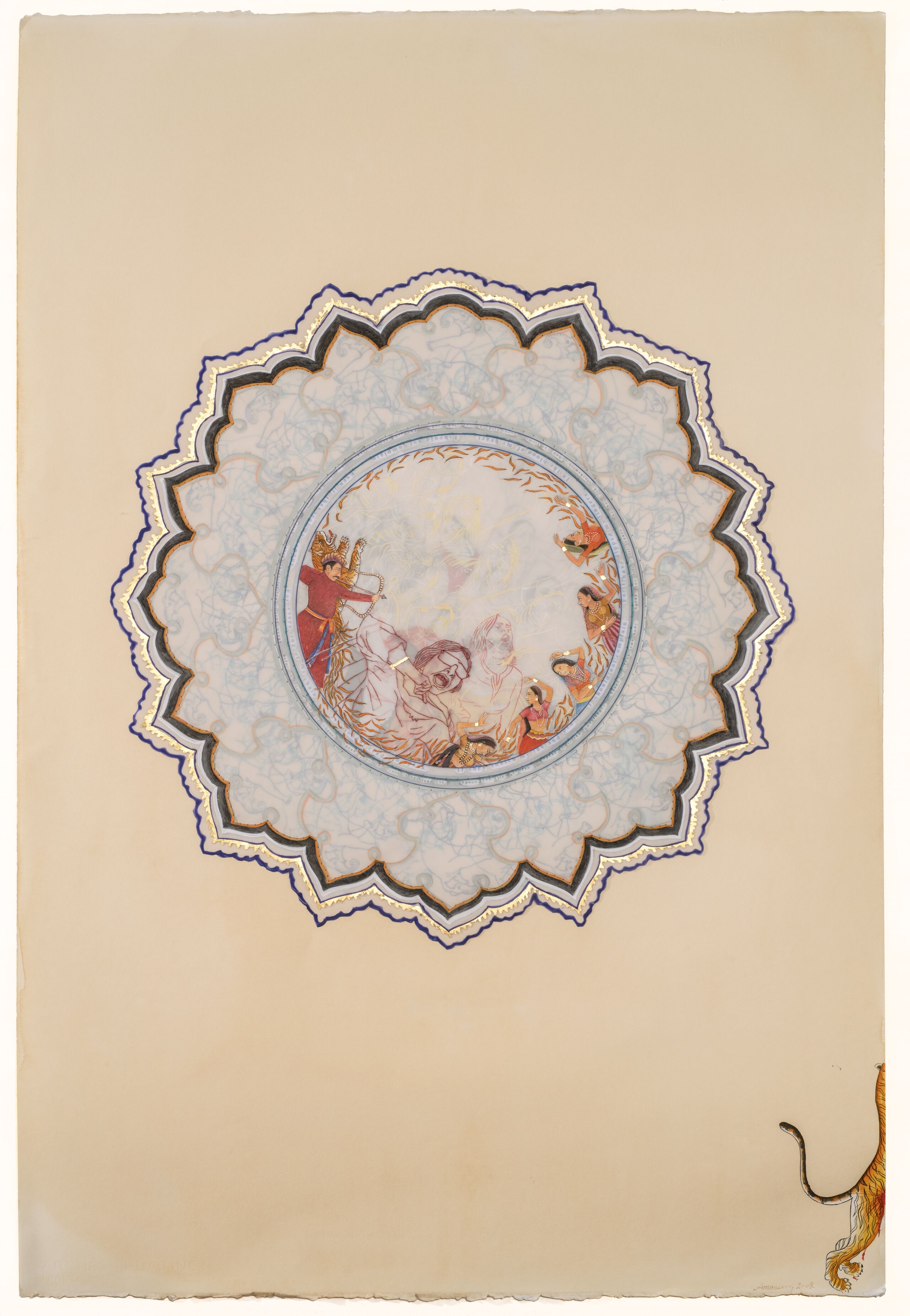
A work on tan paper features an image framed within an intricate shape in light blue, black, and gold. In the center, a circular opening like a camera viewfinder shows images of several screaming women drawn in precise outlines. They appear alongside a man with a bow and arrow and women in traditional South Asian attire. In the bottom right corner, the rear end of a tiger is visible as it walks off the page.
Ambreen Butt, The Great Hunt I, from the series “Dirty Pretty,” 2008; Water-based pigments, white gouache, text, thread, and gold leaf on layers of Mylar and tea-stained paper, 45 x 30 in.; National Museum of Women in the Arts, Gift of the Massachusetts State Committee of NMWA; © Ambreen Butt; Photo by Lee Stalsworth

The Great Hunt I is one of eight artworks from Ambreen Butt’s 2008 series “Dirty Pretty,” inspired by the female Pakistani lawyers who demonstrated against then-President Pervez Musharraf’s suspension of Chief Justice Iftikhar Muhammad Chaudhry in 2007. Meticulously executed using stitching, drawing, and traditional Indo-Persian manuscript painting techniques on layers of Mylar, “Dirty Pretty” imbues the 2007 protests with historical, if not mythic, resonance. Butt blends imagery from press photographs into scenes inspired by Mughal-era manuscript illustrations.

The Great Hunt I represents a climax in the narrative, when the historical nayikas (who reflect a heroine archetype from Indian folklore) guide the protestors through fire, away from the threat of an armed Mughal prince. The nayikas are now feminists who lead their present-day counterparts into legend.

Encircling the image is a blue border collaged with lines from the poem “Speak” by Pakistani writer Faiz Ahmed Faiz (1911–1984). Butt reiterates Faiz’s mandate to speak truth to power, despite violent consequences, through the contorted faces of the protestors.

Artwork Details

  • Artist

    Ambreen Butt
  • Title

    The Great Hunt I, from the series “Dirty Pretty”
  • Date

    2008
  • Medium

    Drawings and Prints, Mixed media
  • Dimensions

    45 x 30 in.
  • Donor Credit

    Gift of the Massachusetts State Committee of the National Museum of Women in the Arts
  • On Display

    No