
Mix Tape: Collection Audio Guide
Online Exhibition
Explore collection highlights throughout the museum in this Remix Mix Tape audio guide. Learn about your favorite artists and discover new artworks.
Installation view of Remix: The Collection; Photo by Kevin Allen Photography for NMWA
Overview
This audio guide is a companion to Remix: The Collection, which showcases familiar collection favorites and never-before-exhibited recent acquisitions on view at NMWA. Hear NMWA curators and educators provide insights on collection highlights throughout the Mezzanine, third floor, and fourth floor.
Eva Gonzalès
Audio
Curator Orin Zahra delves into the portrait’s inspiration and significance by Eva Gonzalès (1847 to 1883)
Read Transcript
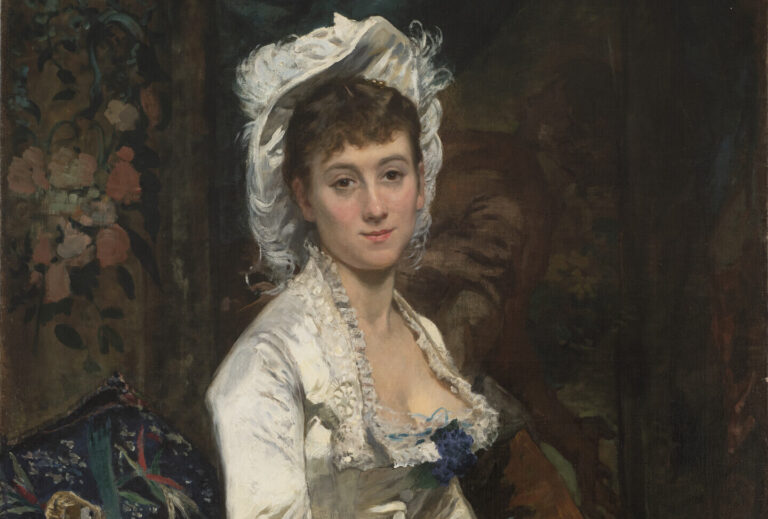
The Modernist painter Eva Gonzalès depicted scenes of contemporary French life, often focusing on the experiences of bourgeois women. In Portrait of a Young Woman, Gonzalès depicts her elegantly dressed younger sister, Jeanne. During the 19th century, the image of a fashionable Parisian woman became a common symbol in art and literature for Paris itself, representing the city’s status as a global center for art, culture, commerce, and innovation. Everything from Jeanne’s dress in its ivory shades of silk and satin, the tasteful gold bangle, the delicate wisps of bird plumes on her hat to even the floral-patterned interior décor were styles that were in vogue at the time.
This painting held pride of place at the home of NMWA’s late founder, Wilhelmina Cole Holladay. Upon entering the residence, visitors were immediately greeted by Gonzalès’s Parisienne, displayed in the family foyer. She looks out at us with a hint of a smile, as stylish, graceful, and evocative now as she was in her day.
Frida Kahlo
Audio
Curator Hannah Shambroom breaks down the symbolism behind the famous self-portrait by Frida Kahlo (1907 to 1954)
Read Transcript
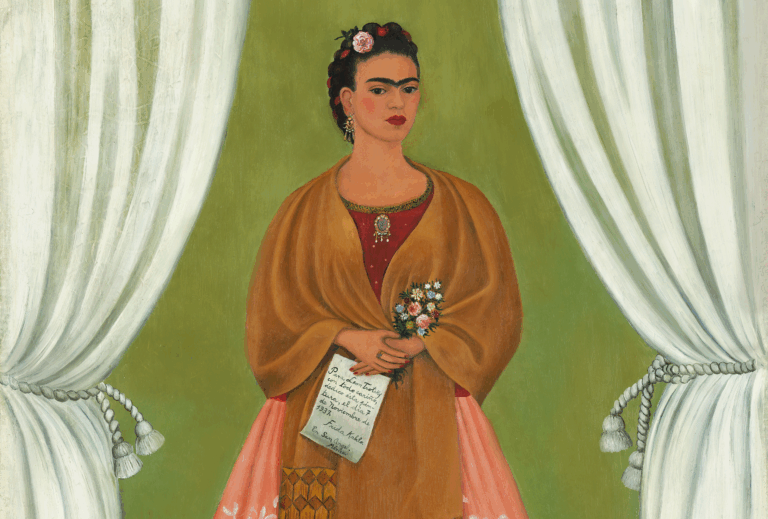
While many are familiar with Frida Kahlo, this self-portrait focuses on a particular moment in the artist’s life, revealing how her art, politics, and personal life were closely entwined. Self-Portrait Dedicated to Leon Trotsky commemorates Kahlo’s affair with the Russian revolutionary and was created on the occasion of his 58th birthday. When Trotsky was exiled from Russia, he and his wife fled to Mexico, where they stayed at the home of Kahlo and her husband. During this time, Kahlo and Trotsky began a brief romantic relationship, and she also learned more about his politics. The way Kahlo presents herself in this portrait reveals the two sides to her own politics. Her letter to Trotsky is in the middle of the composition, centering their relationship and her interest in the international movements of communism and Marxism. Yet she depicts herself wearing a rebozo, a shawl-like garment with many uses, typically worn by women in Mexico. Kahlo’s more traditional clothing choices indicate her allegiance to Mexicanidad, a movement that favored a return to indigenous Mexican roots and folk traditions.
Graciela Iturbide
Audio
Curator Orin Zahra shares how Graciela Iturbide (b. 1942) captures life in Mexico through her black-and-white photographs
Read Transcript
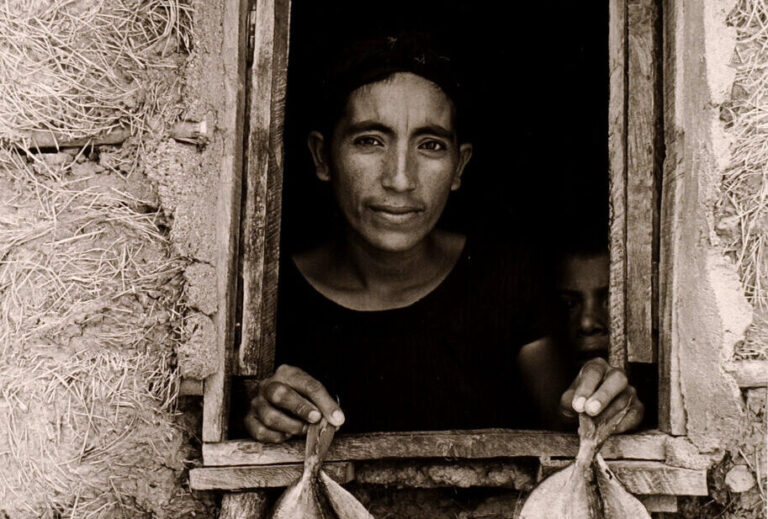
Since the 1970s, Graciela Iturbide has encapsulated urban and rural life in Mexico through her intimate and poetic black-and-white photographs. Iturbide lived amongst Indigenous communities for months, building a sense of trust and collaboration with her sitters. Such was the case with this community of Zapotec women in Juchitán, a small city in the state of Oaxaca in southeastern Mexico.
In Zapotec culture, women are known for their economic, political, and sexual independence. Women in Juchitán generally run the economy, managing and controlling the local outdoor markets.
Iturbide often playfully and artistically records Zapotec women with iguanas, chickens, or, in this case, fish for sale. Animals serve as sources of food and ritual sacrifice, as well as spirit guides for each individual. Her images point to the women’s economic liberties, but also to this important coexistence between people and animals in Juchitán folklore and culture.
Faith Ringgold
Audio
Curator Hannah Shambroom explains what Faith Ringgold (1930 to 2024) and her subject have in common
Read Transcript
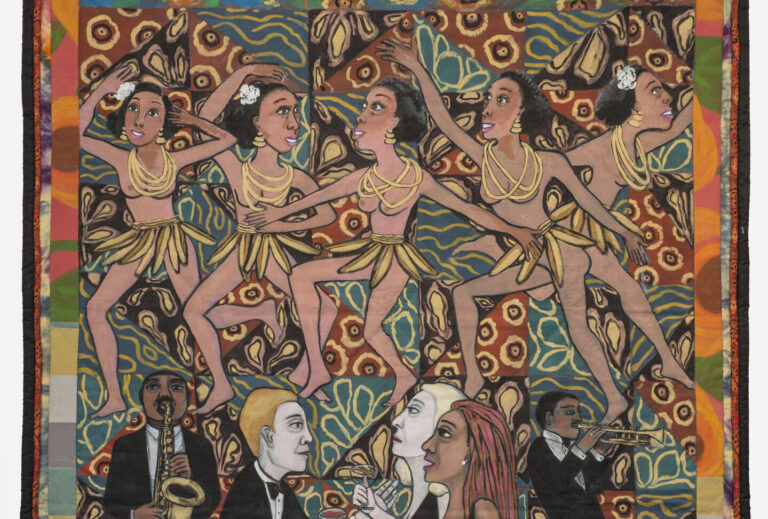
Artist and activist Faith Ringgold is known for her narrative story quilts that pay tribute to important Black cultural figures throughout history. Jo Baker’s Bananas honors renowned dancer Josephine Baker, who rose to fame performing in France in the 1920s. The quilted artwork, created by painting acrylic onto canvas with a sewn fabric border, depicts Baker wearing her signature stage costume, a skirt made of artificial bananas. Ringgold portrays the dancer in five overlapping poses, illustrating her fast-paced moves.
Both Baker and Ringgold were vocal civil rights activists. Baker, already internationally famous by the mid-20th century, refused to perform at segregated clubs in the United States. In 1963, she spoke alongside Dr. Martin Luther King, Jr. at the March on Washington. Ringgold, too, was a champion for racial and gender equality. The artist’s “American People” series, begun in 1963, explored the civil rights movement from a woman’s point of view. In 1971 she co-founded the “Where We At” Black Women Artists collective, a group that advocated for exhibition opportunities for Black women.
Joana Vasconcelos
Audio
Curator Orin Zahra shares about the life, process, and Portuguese influences of Joana Vasconcelos (b. 1971)
Read Transcript
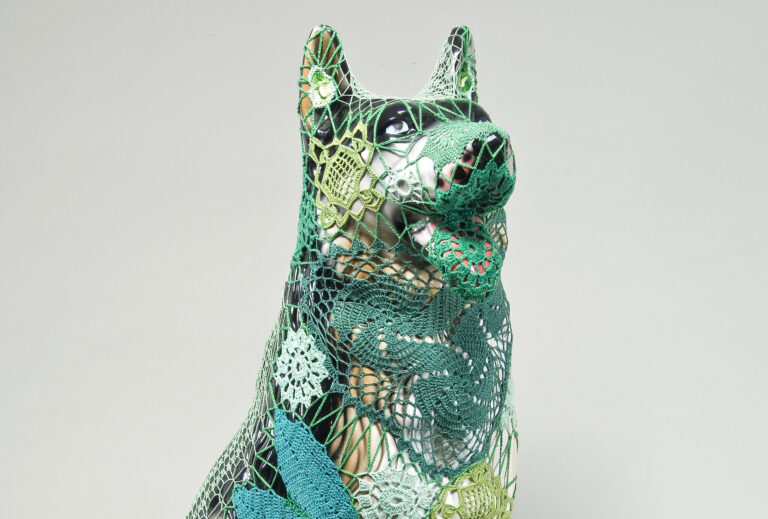
Preoccupied with ideas of womanhood, nationality, and family, Joana Vasconcelos frequently incorporates crafts like knitting and crochet into her art. She also uses common Portuguese household items like ceramic figures. Viriato is one such example of a mass-produced lawn ornament, a ceramic German shepherd, which the artist has swathed in green handmade crochet. This is a tongue-in-cheek commentary on the conditions of domesticity, the yarn fabric covering the dog symbolizes the simultaneous imprisonment and protection of women in the domestic sphere.
Vasconcelos was born in Paris after her family fled the Salazar dictatorship in Portugal and sought refuge in France. They returned to their home country following the Carnation Revolution that overthrew Portugal’s authoritarian regime in 1974. Vasconcelos trained in Lisbon, where she now lives and works. The artist often incorporates elements from her cultural background into her art. Her works possess a decorative and sensual visual language that borrows from the 17th-century Portuguese Baroque style of art and architecture.
LaToya M. Hobbs
Audio
Educator Ashley W. Harris reveals the multi-layered artistic process of LaToya M. Hobbs (b. 1983)
Read Transcript
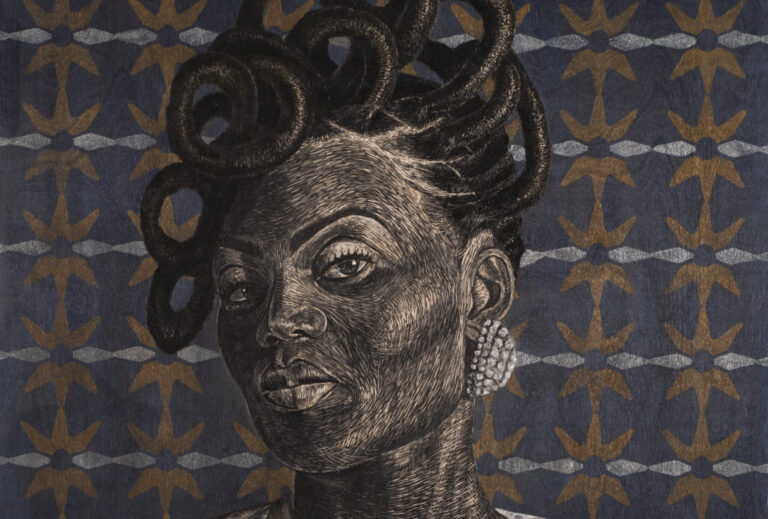
While pursuing a painting degree, LaToya M. Hobbs fell in love with printmaking. To make a print, one surface, known as the matrix, is designed and inked so that the image may be transferred to a second surface. Spending so much time and energy carving blocks for her prints, Hobbs began to see them as more than a tool of creation but rather as beautiful art objects in their own right. In works like The Founder, Hobbs celebrates the matrix by carving a wood panel and adding layers of paint and collage to create a mixed-media artwork. Describing this practice in her own words, she said, “It’s really born out of taking the most important things that I love out of painting and also the most important things that I love about printmaking and bringing them together on the same surface.”
Elizabeth Catlett
Audio
Curator Ginny Treanor discusses the influences that reflect Elizabeth Catlett’s (1915 to 2012) style
Read Transcript
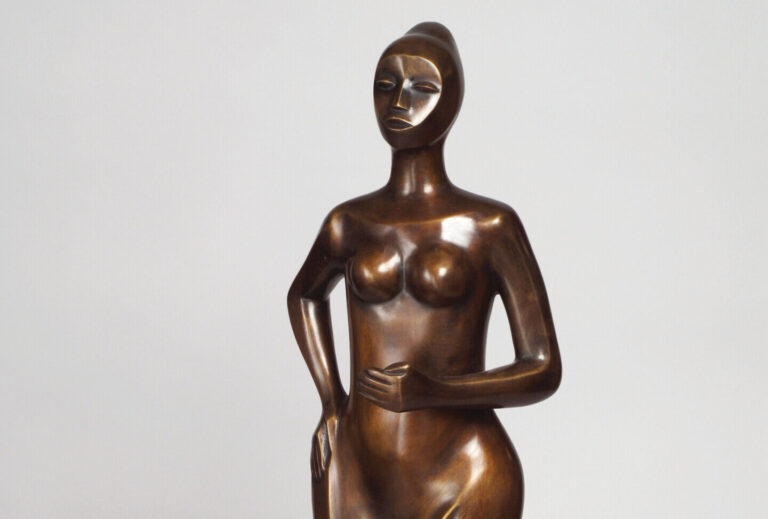
Elizabeth Catlett, who was born in Washington, DC, in 1915 and attended Howard University, is primarily known as a sculptor and printmaker. Catlett went on to obtain her master’s degree from the University of Iowa in 1940, where she was the first Black woman to do so. After time spent in New Orleans, Chicago, and Harlem, Catlett traveled to Mexico in 1946 where she remained for the rest of her long life. Catlett’s style is a reflection of multiple influences, including the stylized forms found in many Pre-Columbian cultures.
In Stepping Out, Catlett evokes the totemic figures found in the art of ancient Egypt, West Africa, and Mesoamerica, while at the same time identifying the subject as a thoroughly modern woman. The woman’s dress and high heels anchor her firmly in the present, and her confident pose conveys pride and strength.
Cindy Sherman
Audio
Curator Kathryn Wat explains the meaning behind Cindy Sherman’s (b. 1954) contemporary tea service
Read Transcript
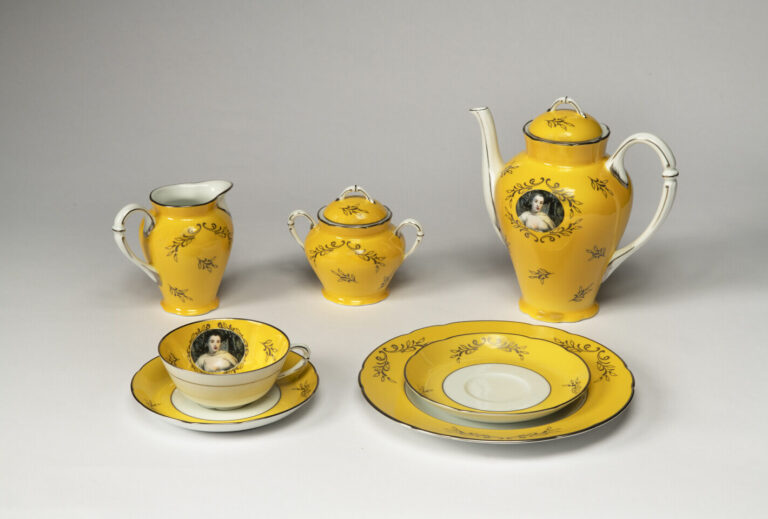
In creating this tea service, artist Cindy Sherman really leaned into her subject. In addition to including a photo of herself dressed as Madame de Pompadour on each porcelain piece, she and the team at Sèvres incorporated fish into the design. This is a nod, of course, to Madame de Pompadour’s surname, Poisson, which means fish in English. If you look closely at the gold flourishes on these pieces, you’ll see eyes and tail fins.
Sherman’s tea set is not a unique work of art. It is a multiple, which is an art object produced in a larger quantity. Sèvres manufactured 75 tea services in this yellow colorway. Not all museums collect multiples, but NMWA does, particularly because women artists have contributed greatly to the evolution of this fun and more accessible art form.
Remedios Varo
Audio
Educator Micah Koppl uncovers the magic behind this Surrealist painting by Remedios Varo (1908 to 1963)
Read Transcript
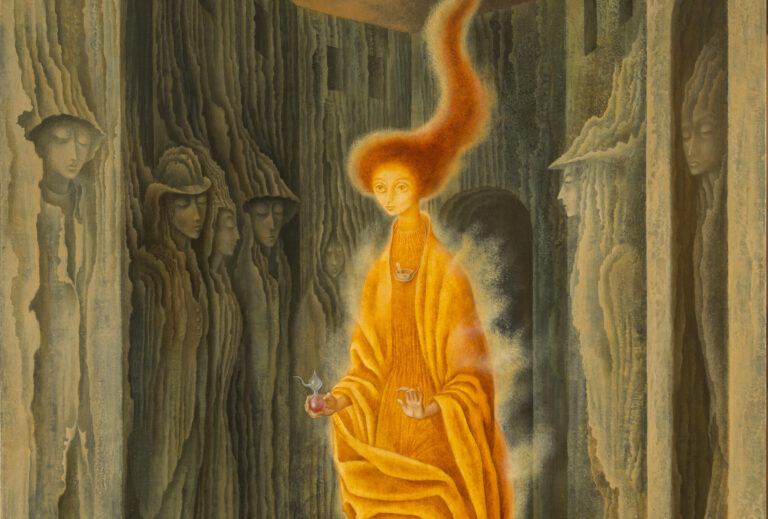
Looking closely at La Llamada, or The Call, by Remedios Varo, you may notice the central figure carrying various intriguing objects. These are alchemical tools, including a mortar and pestle around her neck, that represent a common theme in Varo’s work. Closely associated with the Surrealist artists of the time, Varo was interested in alchemy, astrology, mysticism, science and magic, among many other subjects. The figures in her work are often human-esque and androgenous, with components that appear mechanical or animal in nature. Though not self-portraits, the faces reflect Varo’s own features, particularly her big eyes and long straight nose. She was among the most prominent women artists creating in a surrealist-style and her works, including La Llamada, exemplify the ways Varo broke out of the expected role of woman-as-muse into woman-as-artist.
Sarah Bernhardt
Audio
Curator Hannah Shambroom discusses Sarah Bernhardt (1844 to 1923) as a sculptor
Read Transcript
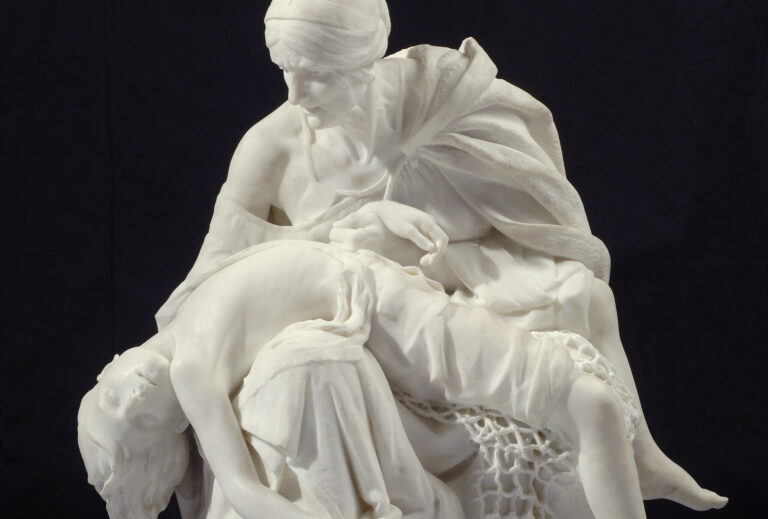
Many know Sarah Bernhardt as one of the most popular French stage actresses of the late 19 and early 20th centuries. But Bernhardt was also an accomplished painter and sculptor. Though she received awards for her work at the Paris Salon, she was criticized by the press and other male sculptors, who accused her of pursuing an activity inappropriate for a woman of her time. Existing sculptures by her are quite rare, and fewer than fifty have been documented.
Après la tempête reveals Bernhardt’s mastery of the medium, particularly in her rendering of soft textures like fabric, netting, and hair in the hard marble. The work also hints at her knowledge of art history, as the arrangement of figures and the woman’s expression of grief are suggestive of Michelangelo’s marble sculpture, Pietà. Après la tempête depicts a true event that Bernhardt witnessed. Walking by the seashore one day, she saw an older woman cradling the body of her grandson, who had drowned after being caught in a fishing net. Though the real-life scene ended in tragedy, Bernhardt hints at hope in her depiction: the child’s right hand grips the woman’s cloak, perhaps suggestive of a happier ending.
Maria Martinez
Audio
Educator Deborah L. Gaston details how Maria Martinez (1887 to 1980) created her signature black-on-black pottery
Read Transcript
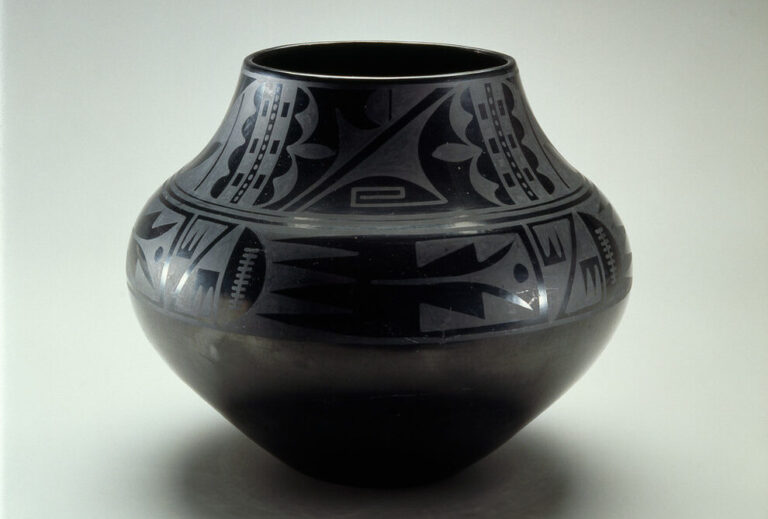
The Pueblo people traditionally used large ceramic vessels like this one for storing water, cooking, and ceremonial purposes. Maria Martinez hand built this jar using coils of clay, a century’s-old process she learned beginning in childhood by observing female relatives. Yet, despite its connections to time-honored practices, this piece was never intended for utilitarian purposes. In fact, the firing process Martinez and her husband Julian used to transform reddish natural clay into blackware yielded pots that were neither as hard as typical household vessels, nor entirely watertight.
Jars like this one functioned instead as fine art objects, increasingly sought by collectors in the 1920s and beyond, who valued their aesthetic properties, especially the mirror-like surfaces and contrasting matte designs. Even the color appealed to a modernist sensibility. Even Martinez herself was once quoted as saying, “Black goes with everything.” Further extending this evolution of utilitarian ceramics into art objects, Martinez began signing her pots, becoming the first Pueblo potter to do so.
Deborah Butterfield
Audio
Butterfield Online Description Curator Kathryn Wat discusses the physicality of this larger-than-life sculpture by Deborah Butterfield (b. 1949)
Read Transcript
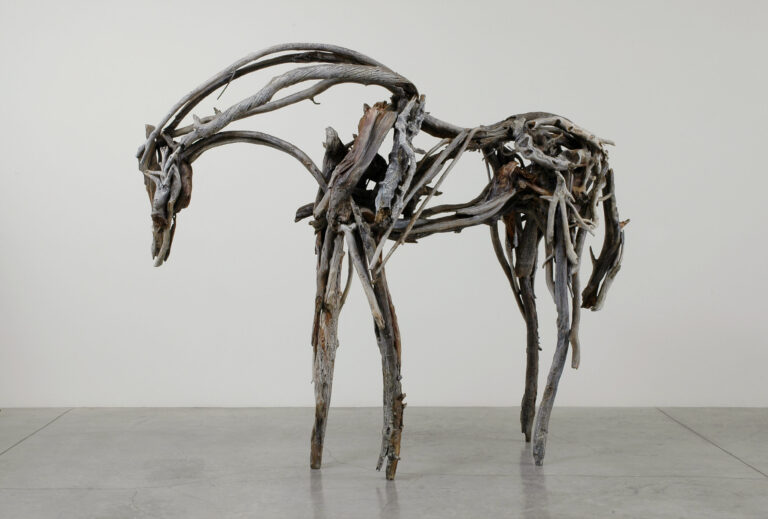
Deborah Butterfield’s sculpture titled Big Horn, it has to be said, is larger than life. It’s not only physically bigger than most horses, it conveys the power of a horse profoundly. Whenever I am touring NMWA’s galleries with visitors, I notice that people tend to avoid standing near the hind quarters of this horse-sculpture because that’s what you would do in real life with a horse that could kick at any moment. Butterfield herself states, “Horses are like the ocean. There is that danger—and the need for respect.”
At varying points in her art-making process, Butterfield is using mud and sticks and steel and bronze, and those materials don’t mimic a horse’s flesh or coat. But, remarkably, the overall structure she created in Big Horn most definitely communicates the sensation of a horse’s movements and mood.
Judy Chicago
Audio
Educator Adrienne L. Gayoso explores the breadth of Judy Chicago’s (b. 1939) material experimentation
Read Transcript
American feminist artist, educator, and writer Judy Chicago began her career as a Minimalist. Yet the breadth and depth of her work, subject matter, and processes suggest she is anything but.
Chicago’s subject matter investigates birth and death; the personal and the political; sexuality and gender; historical and contemporary women; and even extinct, endangered, and domesticated animals (cats may be her favorite).
Her experimentation with a variety of materials blurs lines between industrial manufacturing, craft, and fine art. She has explored the ephemeral, including dry ice and colored smoke, and more permanent media, such as porcelain, textiles, photographs, and prints. Chicago is known for gaining skills, like auto painting, and gathering specialists, from embroiders to pyrotechnicians, to bring her ideas to life.
Claude Raguet Hirst
Audio
Educator Adrienne L. Gayoso gets into the details of Claude Raguet Hirst’s (1855 to 1942) work
Read Transcript
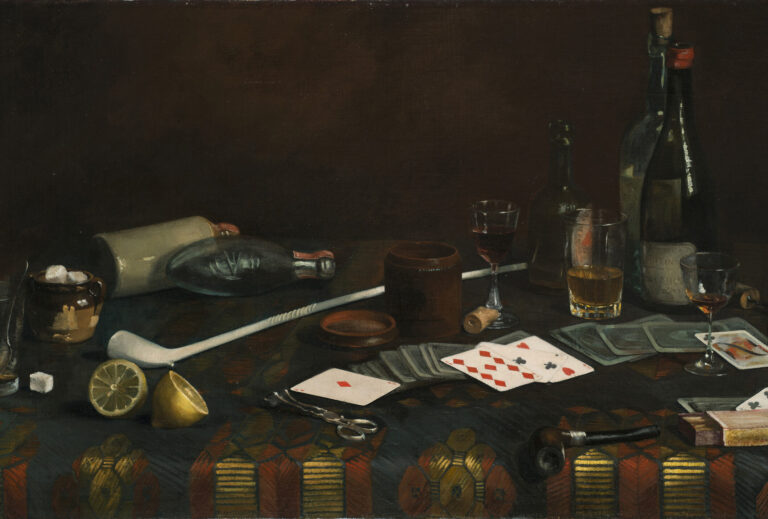
Some items on A Gentleman’s Table by Claude Raguet Hirst may be familiar, like the strewn playing cards, abandoned drink glasses, and the squat Bass Ale bottle, while others are less so. The clear ovoid vessel resting on its side is known as a torpedo bottle and likely held a carbonated beverage. The long white object is a clay Churchwarden pipe, and its cylindrical neighbor stored tobacco.
One object here has a personal connection to Hirst. Notice the pipe resting precariously on the edge of the table. While sharing her New York City studio with a fellow artist, Hirst drew inspiration from his clutter: “He always left things about and one day I noticed a fine old meerschaum pipe. I had to sit right down and paint it.” That messy man became her husband. And after his death, smoking objects disappeared from her work entirely.
Rosa Bonheur
Audio
Educator Adrienne L. Gayoso travels back in time to Rosa Bonheur’s (1822 to 1899) depiction of the Scottish Highlands
Read Transcript
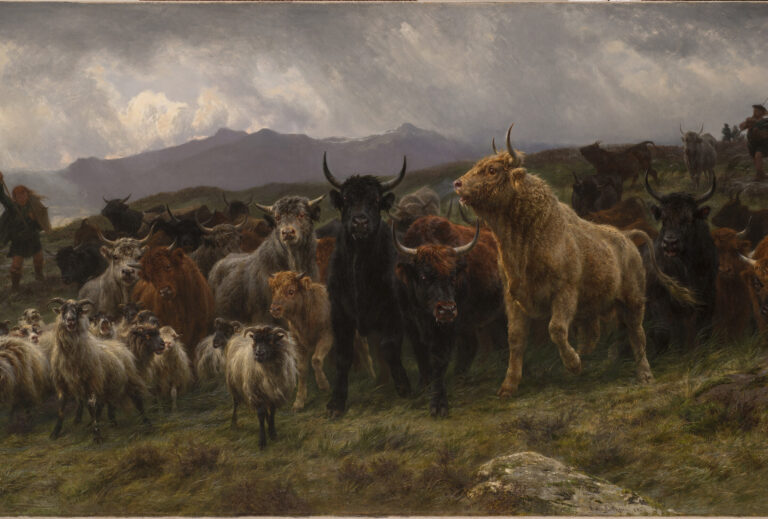
Where have you traveled that left a lasting impact? For animal lover and painter Rosa Bonheur, it was Scotland, where she toured with her partner Nathalie Micas in 1856. Bonheur trekked through the rugged terrain and wet weather of the Scottish Highlands. There she closely observed and sketched ovine and bovine subjects. This experience informed much of her output over the next decade, including Highland Raid. This work’s large-scale, minute details and dramatic mood often stop viewers in their tracks, much as the herded livestock seem frozen on this road, or raid in Old English. Though she occasionally painted people, as we see here, her lifelong passion was depicting realistic and expressive animals. In Bonheur’s words, “As far as males go, I only like the bulls I paint.”
Loïs Mailou Jones
Audio
Educator Micah Koppl examines Loïs Mailou Jones (1905 to 1998) making her mark as a prominent artist
Read Transcript
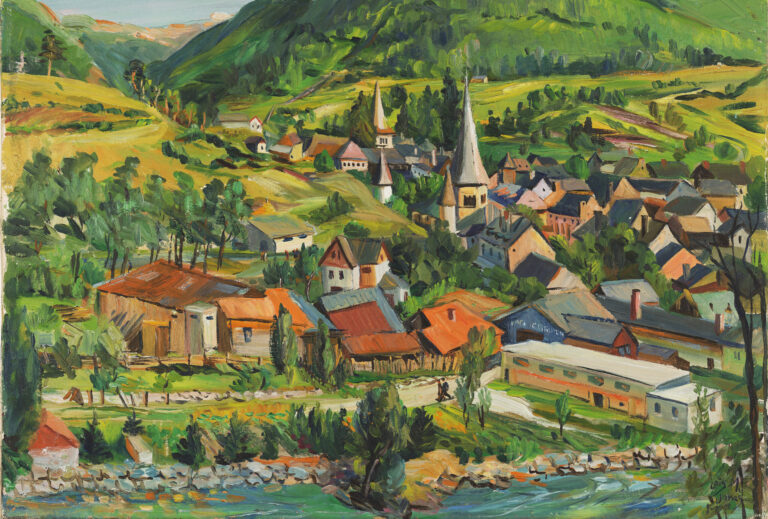
Loïs Mailou Jones began her career as a textile designer for companies in Boston and New York City. By the time she was 22, her patterns were produced and sold across the US. Jones struggled with the anonymity of the design world, along with the racism and sexism she faced as a Black woman artist. In the 1930s, she moved into the next phase of her career. In her own words: “I realized that my name was…never published with the designs. As I wanted my name to go down in history, I realized that I would have to be a painter. And so it was that I turned immediately to painting.” Looking closely at Arreau, Hautes-Pyrénées, in the lower right-hand corner of the work, you’ll notice Jones’s signature tucked into the foliage. Jones also signed and dated the back of this canvas.
Jaune Quick-to-See Smith
Audio
Curator Orin Zahra explores narrative landscape artworks by artist-activist Jaune Quick-to-See Smith (1940 to 2025)
Read Transcript
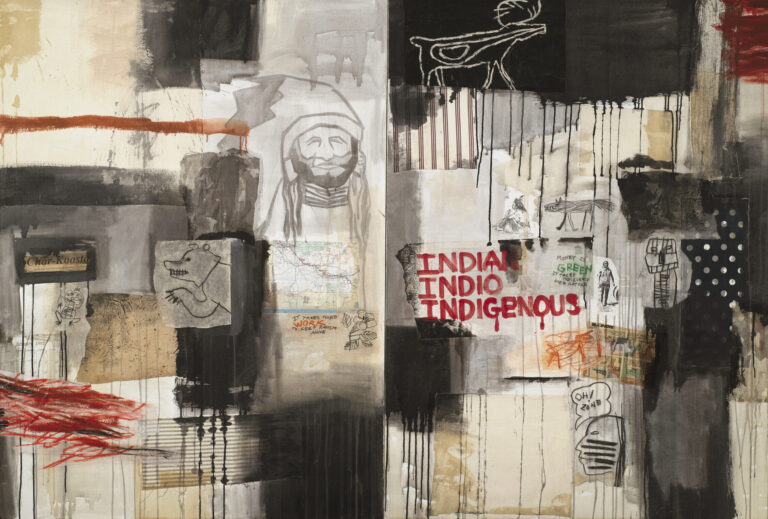
Jaune Quick-to-See Smith is an enrolled member of the Confederated Salish and Kootenai Nation in Montana. Deeply connected to her heritage, Smith creates work that is rooted in storytelling. Her politically charged and humorous imagery combines texts and popular culture alongside desert landscapes, horses, maps, and petroglyphs. Smith refers to paintings like Indian, Indio, Indigenous as narrative landscapes. We see pictographs of the natural world, like bear, coyote, and deer, juxtaposed with mocking inscriptions such as, “It takes hard work to keep racism alive” and “Money is green: it takes precedence over nature.” Smith sharply critiques the destruction of the environment and Native American culture as a result of Euro-American influence and corporate greed.
Smith calls herself a cultural arts worker. Not only is she an artist, but she is also an educator, curator, and activist. While training in the arts, she recalls being told by a professor that women could not be artists, and later discovered that only Native American men exhibited in galleries. Smith became dedicated to championing Native American women artists and has consistently organized and curated exhibitions since the 1970s.
Alice Neel
Audio
Educator Deborah L. Gaston delves into Alice Neel’s (1900 to 1984) unflinching portrayals
Read Transcript
Alice Neel consistently rejected the term “portrait” as a descriptor for her blunt, often confrontational paintings, preferring instead to call them “pictures of people.” When an interviewer asked why, Neel responded unequivocally: “Portraits are where more crimes are committed than any other form of art,” she said, continuing, “I mean, witness the [paintings of] college professors that hang on walls in petrified form. I think they’re frightful. But I break those rules, and they’re considered bold by timid people. They’re not really bold. They’re just the truth.”
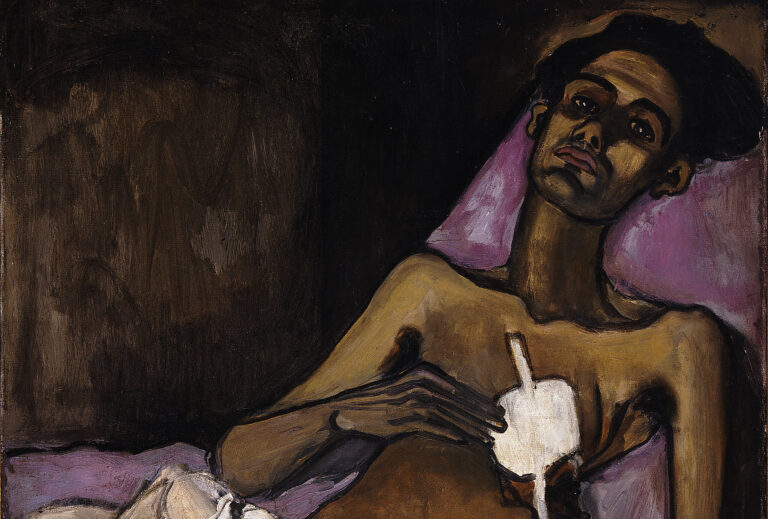
As a self-described “collector of souls,” Neel created “pictures of people,” ranging from the suffering resident of Spanish Harlem seen here to pregnant women and the art world elite. She believed strongly that every human being was worthy of her attention, regardless of race, gender, or economic condition. At the same time, she refused to idealize any of her subjects. Of her unflinching portrayals, she explained: “In the process of painting someone, I reveal not only what shows, but what doesn’t show.”
Hung Liu
Audio
Educator Ashley W. Harris decodes the symbolic imagery in Hung Liu’s (1948 to 2021) painting
Read Transcript
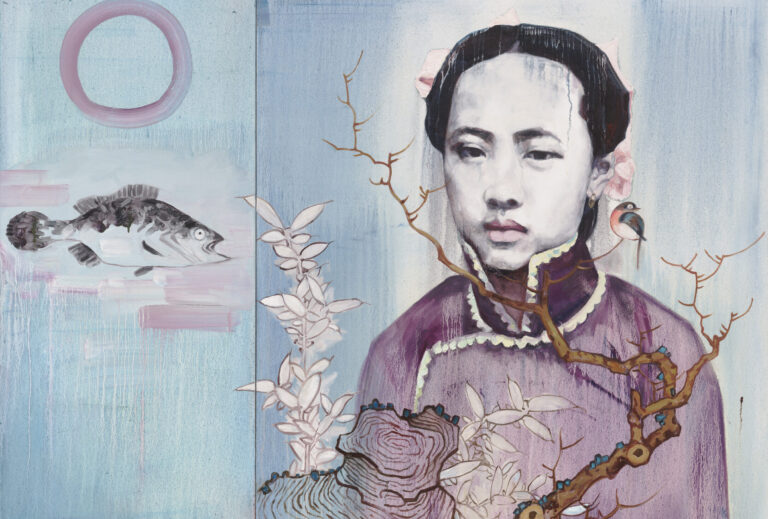
Frequently using 19th-century portrait photographs as source material, Hung Liu uses her paintings and prints to elevate those who were often exploited in their lifetimes and have been lost to history. This is part of a series of four two-paneled paintings or diptychs. Featuring a female figure on the larger canvas and a “cynical fish” on the smaller one, each painting is layered with symbolic imagery, some recurring, like Liu’s signature drips and ever-present circles, and others selected for the season, such as the white bamboo. As Liu described, “It’s my offering to honor them, and the fish can accompany the women in all four seasons…I’d like to summon their ghost spirits, to make sure they are not forgotten. My painting them is to memorialize them.”
Maria Sibylla Merian
Audio
Curator Ginny Treanor discusses Maria Sibylla Merian’s (1647 to 1717) travels to South America
Read Transcript
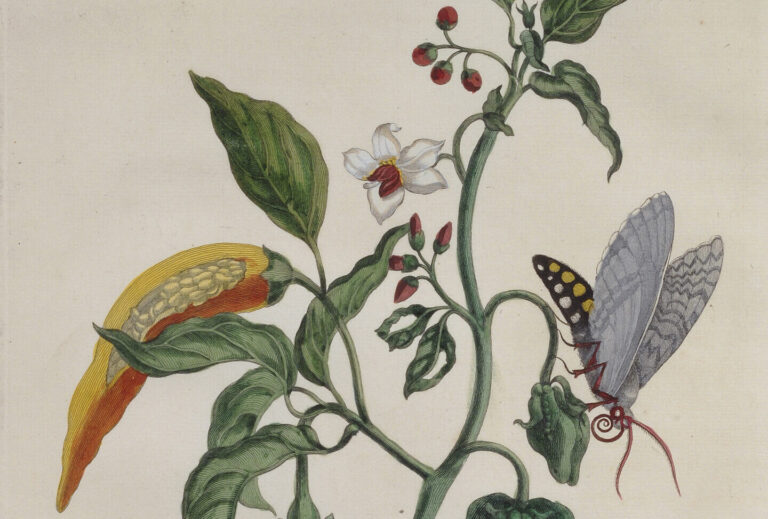
Captivated by the natural world around her, Maria Sibylla Merian put her artistic talents to use documenting her observations, even going so far as to raise caterpillars in her home in order to witness firsthand the process of metamorphosis.
This unwavering pursuit of knowledge led Merian to board a ship in Amsterdam in 1699 and travel to the Dutch colony of Suriname in South America. Her goal was to record her findings about the flora and fauna of the region, which were completely unknown to most Europeans at the time.
Suriname’s plantations of sugar, cotton, and indigo depended on the labor of enslaved Africans and Indigenous inhabitants. While there, Merian also relied on enslaved labor to assist her in the collection of specimens. She relied on the knowledge of enslaved individuals about the plants and animals which she studied. Many of their observations were recorded by Merian and included in her book, Dissertation in Insect Generation and Metamorphosis in Surinam, which she published upon her return to Amsterdam.
Lavinia Fontana
Audio
Educator Deborah L. Gaston reveals Lavinia Fontana’s (1552 to 1614) success as the family breadwinner
Read Transcript
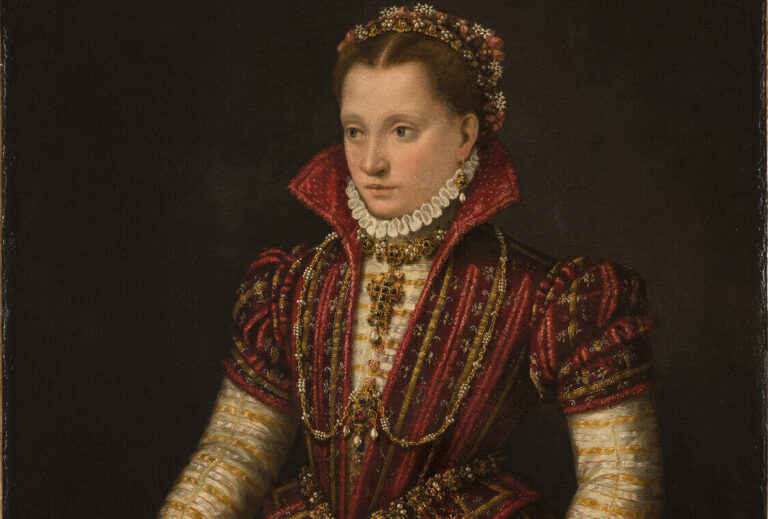
Like the bride she portrayed in this painting, Lavinia Fontana married and had children. But the similarities largely end there. Following her marriage, Fontana became the family’s breadwinner, supporting her husband and their 11 children.
Fontana’s ability to build and sustain the network of patrons required for such success had much to do with the powerful and influential noblewomen of Bologna. A 1678 book about the city’s painters highlighted Fontana’s celebrity status, noting:
“For some time, all the Ladies of the City would compete in wishing to have [Fontana] close to them, … considering themselves fortunate to have seen her on the street, or to have meetings in the company of the virtuous young woman; the greatest thing that they desired would be to have her paint their portraits.”
Fontana’s talents also included business savvy, for she named many of these noblewomen as godmothers for her numerous children, thus securing additional connections to the most influential families in Bologna.
Alison Saar
Audio
Educator Ashley W. Harris uncovers the many meanings of Alison Saar’s (b. 1956) skillets
Read Transcript
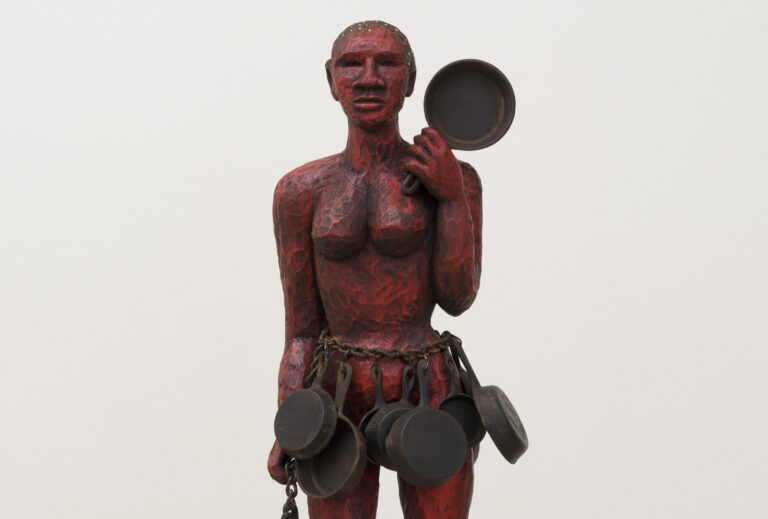
Scorch Song is part of Alison Saar’s continued exploration of the multiple meanings and uses of the tools of domestic labor in relation to Black bodies. As she explains, “housekeepers and nannies have a huge impact on people’s lives, and they are rarely recognized.” On the other hand, items like cast iron skillets elicit fond memories of her grandmother’s, mother’s, and her own kitchen, a space for gathering, nourishment and creation. In this piece, the skillets become a source of strength. According to Saar, “her cookware is transformed into a weapon of defense, and if necessary, warfare. With one skillet gripped overhead, the formidable nude holds her ground, steadfast, confident, courageous, and unmovable.” However, Saar gives viewers permission to interpret her art in their own way. Consider the figure’s stance and color. Look closely at all the materials employed. What do they evoke for you?
Niki de Saint Phalle
Audio
Curator Hannah Shambroom discusses the iconic Nana sculptures of Niki de Saint Phalle (1930 to 2002)
Read Transcript
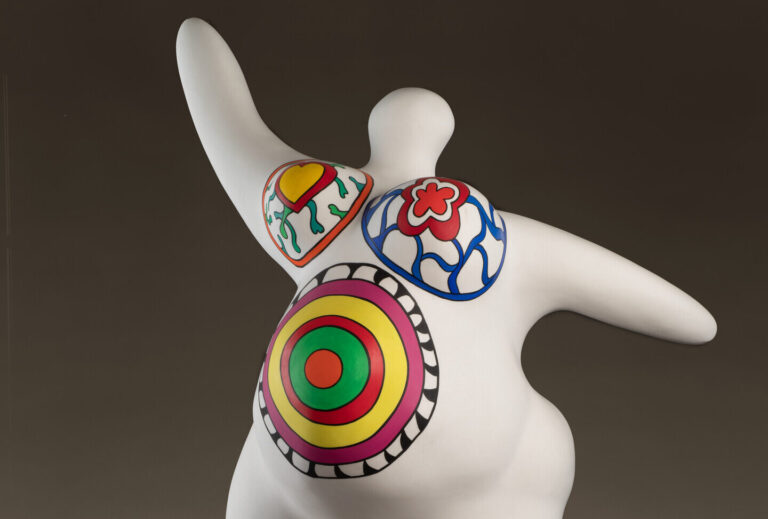
A trailblazing figure of the mid-20th century, Niki de Saint Phalle conveyed her feminist vision through colorful works of art. In the 1960s, Saint Phalle took aim at patriarchal power structures with her Tirs paintings. These assemblages featured found objects and paint containers embedded in plaster, which, when punctured by the artist with rifle fire, sprayed color across the otherwise white artworks. Eventually, Saint Phalle shifted towards figural representation in her work and a softer approach to her feminism. Her Nanas, simplified representations of female bodies covered in colorful patterns, are often posed in motion with outstretched arms and legs. While playful, they also reflect the mid-20th century archetype of the liberated woman. “I am not someone who can change society, except through showing some kind of vision of these happy, joyous, domineering women,” she said. Pregnant Nana depicts a woman with enlarged breasts and buttocks and a protruding stomach, inspired by ancient fertility statuettes. While the realities of pregnancy and motherhood are nuanced, this work projects energy and joy.
Alma Woodsey Thomas
Audio
Educator Deborah L. Gaston shares Alma Woodsey Thomas’s (1891 to 1978) legacy as an artist and teacher
Read Transcript
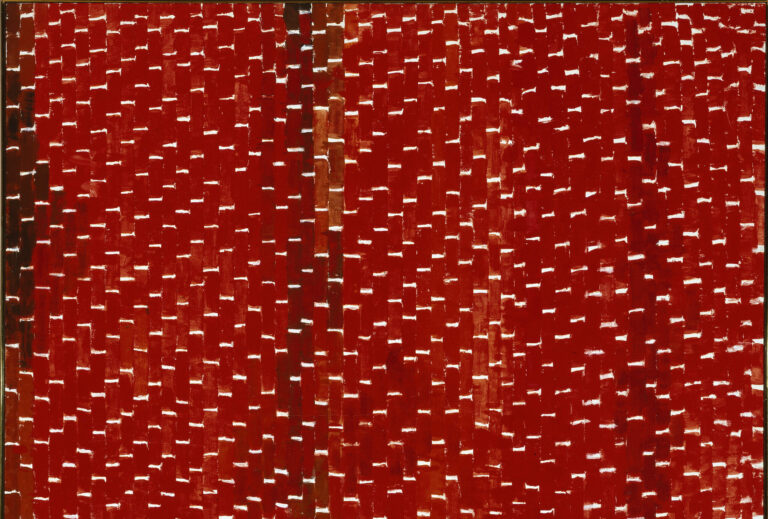
Before Alma Woodsey Thomas became the first African American woman with a solo exhibition at New York’s Whitney Museum of American Art when she was 81. And before she debuted her vibrant abstract style at the age of 75, she was a dedicated and inspiring educator.
For 35 years, Thomas taught at Shaw Junior High School, the first Black junior high in Washington, DC. As art teacher, she developed curriculum and programs that centered African American history. She prioritized the works of Black artists, frequently inviting guests to meet and speak with her students. Equally, she devoted time to cultivating the talents of her students, showcasing their work in the school’s hallways, classrooms, and gallery each February during a week-long celebration, the precursor of our current Black History Month. Thomas particularly valued this role, explaining at one point, “People always want to cite me for my color paintings. But I would much rather be remembered for helping to lay the foundation of children’s lives.”
Yael Bartana
Audio
Curator Kathryn Wat enlightens on the inspiration of Yael Bartana’s (b. 1970) provocative sculpture
Read Transcript
The neon sculpture by Yael Bartana titled What If Women Ruled the World? actually came out of a theatrical performance in which Bartana directed actors who played women scientists, women artists, and women activists seeking solutions to humanity’s most urgent problems. The project was partly a reflection on Stanley Kubrick’s 1964 film Dr. Strangelove, in which a group of men discussed nuclear war and its aftermath.
Bartana’s wall sculpture emits an eerie fluorescent glow, and as you approach it, you’re hit with her provocative question. Regardless of a person’s political outlook, it’s very reasonable to wonder: if women were making policy globally, would the world be different? I especially love seeing people pose for photos next to this sculpture. I think they take Bartana’s idea as real inspiration.