

Marisol
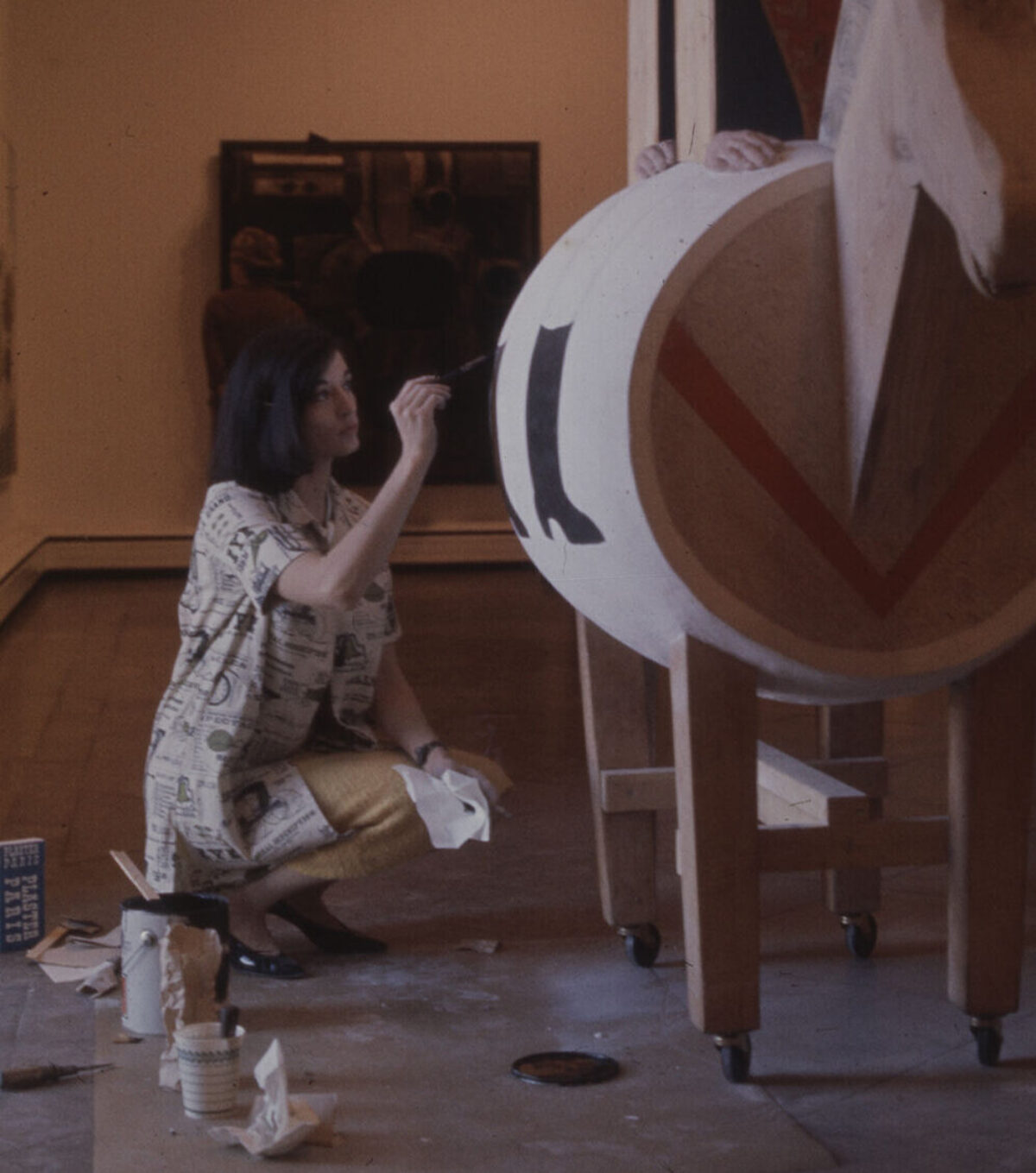
Marisol retouches The Generals, 1962-63, in 1963. Artwork: Collection Buffalo AKG Art Museum; Gift of Seymour H. Knox, Jr., 1962 (K1962:7). © Estate of Marisol / Artists Rights Society (ARS), New York.
Born in Paris to wealthy Venezuelan parents, María Sol Escobar preferred to be known simply as Marisol. The artist’s childhood was nomadic, split between Caracas and New York. Her parents encouraged her early interest in art with frequent trips to European museums. When she was eleven, her mother committed suicide, and Marisol took a vow of silence that she maintained, with some exceptions, until her early twenties. Later, at the height of her celebrity, she remained enigmatically laconic.
Marisol attended high school in Los Angeles, then spent a year studying at the École des Beaux-Arts and the Académie Julian in Paris. Dissatisfied with her education, the artist spent the next few years in New York training at the Art Students League and with German abstract artist Hans Hoffmann. In 1954, she shifted her focus from painting to sculpture following a transformative encounter with pre-Columbian art.
By 1957, Marisol had developed the blocky assemblages for which she is known. Combining wood, painting, and found objects, her sculptural portraits of families and celebrities were fêted for their wit and empathy. Indeed, while she is often associated with Pop Art, Marisol’s humanizing approach sets her apart from the cool detachment of other Pop artists, especially her friend Andy Warhol.
Over the next decade, Marisol achieved a level of international fame that she found uncomfortable. In 1968, after representing Venezuela at the Venice Biennale, she withdrew from the art world and spent the next few years traveling. Although she resumed her artistic production in the mid-1970s, exploring subjects such as Georgia O’Keeffe and Leonardo’s Last Supper, Marisol remained an obscure figure at the time of her death. However, the legacy of this visionary artist has recently been secured with multiple monographic exhibitions and publications, including Marisol: A Retrospective, organized by the Buffalo AKG Art Museum in 2023.
