

Between the Curtains: Frida Kahlo's Self-Portrait
Get a peek behind the curtains of Frida Kahlo’s iconic painting, Self-Portrait Dedicated to Leon Trotsky (1937).

Overview
“I never painted dreams. I painted my own reality.”
–Frida Kahlo
Mexican painter Frida Kahlo (1907 to 1954) is known for creating striking, often shocking self-portraits that reflected her political ideology, cultural identity, and her turbulent personal life.
In Self-Portrait Dedicated to Leon Trotsky, Kahlo is framed between two curtains, a new Madonna of the people, wearing traditional Tehuana attire. She holds a letter that is both a declaration of political allegiance and personal affection for the exiled Russian Communist leader Leon Trotsky, with whom she had developed a close friendship and had a brief affair.
Upon arriving in Mexico in January 1937, and under Rivera’s protection, Trotsky and his wife Natalia Sedova lived in Casa Azul, Frida’s family home, for two years. Frida enshrined their relationship in this portrait, which she gave to Trotsky on his 60th birthday. It hung in his private study in Casa Azul until the Trotskys moved to a new safe house in 1939.
Frida Kahlo
Mexican painter Frida Kahlo is known for creating striking, often shocking, self-portraits that reflected her political ideology, cultural identity, and her turbulent personal life.
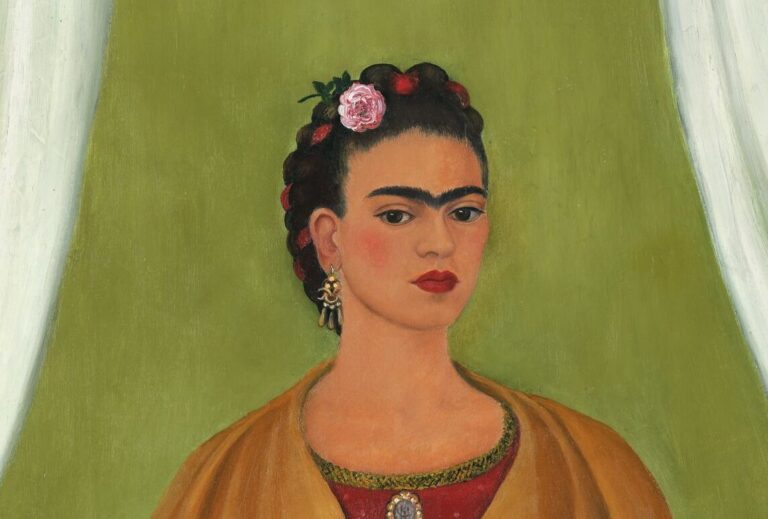
A Closer Look: Clothing and Jewelry
She presents herself elegantly clothed in a long embroidered skirt, fringed shawl, and delicate gold jewelry. She stands center stage, meeting the viewer’s gaze with confidence. Flowers and coils of red yarn adorn her hair and adroitly applied makeup highlights her features.
Her usual bright regional dress is replaced by more refined attire: a pale peach skirt with delicate embroidery and a soft, bronze-colored shawl draped across her shoulders like a mantle. Kahlo adorns herself with gold jewelry and fresh flowers. Her elaborately braided hair increases her stature. Kahlo presents herself on a stage, curtains pulled aside, before a backdrop that modulates from ocher to pea green.

A Closer Look: Stage and Curtains
The compositional elements of the stage and curtains, evoke Mexican vernacular paintings called retablos. These devotional images of the Virgin or Christian saints painted on tin were a form of folk art that Kahlo collected.
Framing herself between curtains, Kahlo controls her staged reality to cast herself as a protagonist in a dramatic declaration of political allegiance, as well as love. The imaginary setting in Kahlo’s painting serves as a symbolic space for self-staged expression.

A Closer Look: Letter
Kahlo holds a bouquet of flowers and a letter that reads, “Para Leon Trotsky con todo cariño, dedico ésta pintura, el dia 7 de Noviembre de 1937. Frida Kahlo. En San Ángel, Mexico”.
Self-Portrait Dedicated to Leon Trotsky commemorates the brief affair Kahlo had with the exiled Russian revolutionary leader Leon Trotsky shortly after his arrival in Mexico in 1937, and before his assassination in 1940. Though this painting proclaims her political allegiance to Trotskyism, Kahlo subsequently broke with the movement and became a supporter of Stalin in 1939.
Whereas the subject of the painting reveals Kahlo’s engagement with international politics, the Mexican folk art-inspired style illustrates her devotion to Mexicanidad. This post-Revolutionary movement that emphasized Mexican nationalism and eschewed European influences.

Further Reading
Frida Kahlo Papers
Explore a selection of letters from NMWA’s archival collection that includes digitized scans and accessible transcriptions, bringing to life the heartfelt letters between the artist and her friends, colleagues, and beloved family.
Letter from Mary Sklar to Frida Kahlo
In a letter from close friend Mary Sklar, Sklar writes:
Trotsky’s death must have
knocked all political faith out
of you. I knew it was coming
sooner or later, but it was a
shock just the same — and
the worst part of it came
afterward when Meyer and I read
in the Times a Tass dispatch
to Moscow saying that Trotsky
had been killed by one of his
own followers and we saw the
face of our old friend Kenneth
Durant who is editor of Tass
as something sinister and brutal,
knowing how responsible they must
have been themselves.
