

Queer Activism in the Arts
Take a closer look at five influential artists from the museum’s collection who have pushed boundaries and inspired others through their art.

Overview
While 19th-century Paris, 1980s New York, and Johannesburg in 2007 may seem worlds apart, each of the featured artists has challenged the constraining societal structures of their time. The paintings of Rosa Bonheur (she/her) were wildly popular among traditional society of the 1800s in Europe and America, but her life and success were well outside the societal norms for women at the time. Photographers Berenice Abbott (she/her), Alice Austen (she/her), Nan Goldin (she/her), and Zanele Muholi (they/them) use their work to create varied and personal portraits of people within subcultures and LGBTQIA+ (lesbian, gay, bisexual, transgender, queer, intersex, and asexual) communities.
Rosa Bonheur
Rosa Bonheur (b. 1822, Bordeaux, France; d. 1899, Thomery, France)
In a time when the idea of a woman walking into a restaurant unchaperoned was scandalous, Rosa Bonheur forged her own path and built a life that did not fit within the boundaries of societal norms. When she wanted to wear men’s clothing, in part to support her artistic practice, she applied for a “cross-dressing” permit from the Prefecture of Police to avoid being arrested for wearing pants. Today, Bonheur is considered a queer icon and has served as a role model for generations of women artists.

Rosa Bonheur
Rosa Bonheur, a 19th-century woman who achieved a successful career, served as a role model for future generations of women artists.
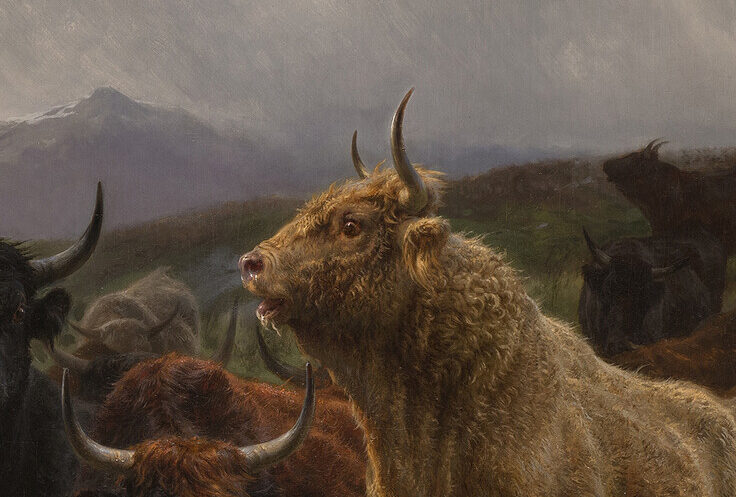
The Highland Raid
While unconventional in her ambitions and personal conduct, Bonheur was trained in traditional working methods. She studied her subjects carefully and produced many preparatory sketches before she applied paint to canvas as demonstrated in The Highland Raid (1860). It was in the gritty butcher shops and slaughterhouses of Paris that Bonheur closely studied animal anatomy to prepare for her paintings.

In Rosa Bonheur’s Own Words
Why shouldn’t I be proud to be a woman? My father, that enthusiastic apostle of humanity, told me again and again that it was woman’s mission to improve the human race…To his doctrines I owe my great and glorious ambition for the sex to which I proudly belong, whose independence I’ll defend till my dying day. Besides, I’m convinced the future is ours.
Nan Goldin
Nan Goldin (b. 1953, Washington, DC)
Nan Goldin came of age as a documentarian. he began photographing the lives and loves of her circle of friends in the city’s art, gay, and cross-dressing communities while studying at the School of the Museum of Fine Arts, Boston, before moving to New York after graduation. She has created more than 800 grainy, hard- and soft-focus images chronicling her involvement in the city’s subcultures.

Nan Goldin
Nan Goldin creates uncomfortably personal photographs that shatter traditional notions of fine art photography.
Self-Portrait in Kimono with Brian, NYC
Self-Portrait in Kimono with Brian, NYC (1983) is part of Nan Goldin’s epic work The Ballad of Sexual Dependency (1981 to 1996). Comprising hundreds of photographs, it documents the bohemian lives of Goldin and her friends in downtown New York City.
Goldin’s photographs of her community, in the intimate spaces of their homes and hangouts, are gritty and unsparing. With uneven lighting and focus, her photographs have the feel of on-the-run documentary works. Yet, her subjects are highly personal.

In Nan Goldin’s Own Words
“People take [snapshots] out of love, and they take them to remember—people, places, and times. They’re about creating a history by recording a history. And that’s exactly what my work is about.”
Zanele Muholi
Zanele Muholi (b. 1972, Umlazi, South Africa)
South Africa legalized same-sex marriage in 2006, yet members of the LGBTQIA+ communities still face hate crimes and violence. That same year, Zanele Muholi began taking black-and-white photographs of individuals to redress the lack of visual documentation of the South African LGBTQIA+ communities.

Zanele Muholi
Fueled by their activism, Zanele Muholi’s photography confidently depicts queer love and joy to combat anti-LGBTQIA+ discrimination.
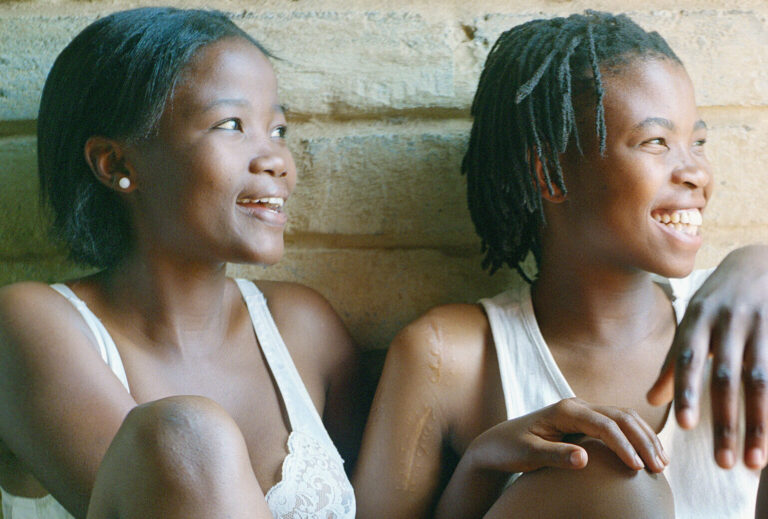
Katlego Mashiloane and Nosipho Lavuta, Ext. 2, Lakeside, Johannesburg
This portrait by Muholi of two women from Lakeside, Johannesburg, expresses a sense of enchantment and happiness, defying the discrimination and violence often directed toward queer people in South Africa. By capturing this couple in moments of intimacy and affection, Muholi emphasizes their humanity.

In Zanele Muholi’s Own Words
“I prefer to be a visual activist because most of the issues that I try to deal with in my work, they deal with human rights…so visual activism is basically dealing with a political agenda and using visuals as a means of articulation.”
Alice Austen
Alice Austen (b. Rosebank, New York, 1866; d. Staten Island, New York, 1952)
One of the earliest women photographers to work outside of the studio and in the public eye, Alice Austen photographed people in her hometown on Staten Island and, later, on the streets of New York City. Austen learned the principles of photography, including how to process glass plate negatives, from an uncle who taught chemistry at Rutgers University. She also traveled widely, photographing the World’s Columbian Exposition in Chicago in 1893 and the Pan-American Exposition in Buffalo in 1901.

Clear Comfort
Austen spent 56 years in a loving relationship with her partner Gertrude Tate, until they were evicted from their home after the stock market crash in 1929. Today, that home, Clear Comfort, is the site of the Alice Austen House.

Featured Alice Austen Artworks


Use the left and right arrow keys to navigate through the slides.
Berenice Abbott
Berenice Abbott (b. Springfield, Ohio, 1898; d. Monson, Maine, 1991)
Berenice Abbott (1898 to 1991) opened a photography studio in Paris in the 1920s and created portraits of members of the city’s artistic and expatriate communities. Abbott became a sought-after photographer of progressive American women expatriates, including gallerist and artist Betty Parsons (1900 to 1982) and Djuna Barnes (1892 to 1982), author of the lesbian cult classic Nightwood (1936).

Berenice Abbott
Berenice Abbott is recognized as the originator of documentary photography or photojournalism. No other photographer had yet used it so broadly for realistic documentation.
A Closer Look
Contact prints depicting actor Eva Le Gallienne, journalist Janet Flanner, and writer Djuna Barnes communicate the subjects’ identities as the era’s “new women.” They pose casually, each impatiently fingering the fabric of a sleeve or resting her chin on her hand. They do not look at the camera, giving the distinct impression that posing prettily was not a priority.
Featured Berenice Abbott Artworks


Use the left and right arrow keys to navigate through the slides.
In Berenice Abbott’s Own Words
“The world doesn’t like independent women, why, I don’t know, but I don’t care.”