

The museum’s late founder, Wilhelmina Cole Holladay, long championed women artists in Pueblo pottery, a field in which women have predominated and passed down their traditions to younger generations. Holladay and her husband, Wallace, donated significant examples of Indigenous pottery to NMWA upon its founding in 1987—several of these are featured in Burnished: Pueblo Pottery at NMWA, on view through September 27, 2026. This exhibition also includes works on loan from the collection of their son Hap Holladay, who carries on his parents’ advocacy for women in this dynamic art form.
Market for Pueblo Pottery
For millennia, potters in the Southwest have been creating vessels for ceremonial and cultural purposes. The 20th century marked swift growth in the field, as Indigenous makers increasingly produced pottery for a burgeoning market of traders, art dealers, and collectors. The Santa Fe Indian Market, organized to promote regional tourism, is the oldest and largest juried art event specializing in these works, dating back to 1922. The market flourished in the late 1960s with renewed interest from collectors, and it continues today with an exceptional range of Indigenous arts representing hundreds of federally recognized nations across the United States.
The artists in Burnished frequently showed at the Indian Market. San Ildefonso Pueblo (Po-Woh-Geh-Owingeh) potter Maria Martinez (1887–1980) became a fixture for collectors there, and by the mid-1920s, museums started acquiring examples of her elegant black-on-black ware, which features highly contrasting burnished and matte surfaces. The matriarch of Santa Clara Pueblo (Kha’P’o) potters, Margaret Tafoya (1904–2001), won numerous awards there throughout her career. Emma Lewis- Mitchell (1931–2013), from Acoma Pueblo, known for her revival of Ancestral Puebloan designs from the Mimbres and Anasazi cultures, first participated in the market in 1960 and continued to earn accolades there over the next four decades.
Tradition and Invention
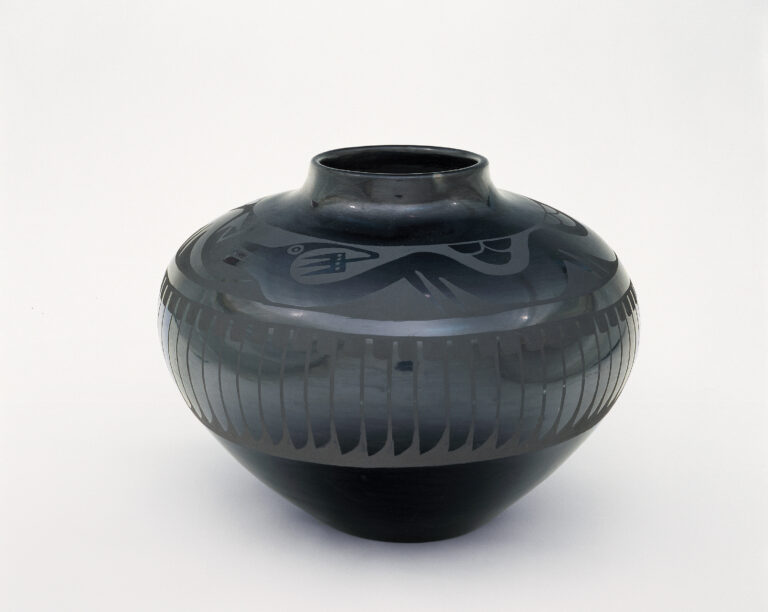
While the works in Burnished were created to be sold to collectors, artists craft each individual piece with motifs and designs that convey personal meaning and cultural value. The Avanyu, for example, is a horned water serpent indicating the importance of water for Pueblo peoples living in an arid desert landscape. A powerful deity, the Avanyu connects the earthly and spiritual realms, symbolizing clouds, rain, and lightning. On NMWA’s blackware jar by Maria Martinez and her daughter-in-law Santana Roybal Martinez (1909–2002), the serpent’s zig-zagging body echoes the undulating movement of water.
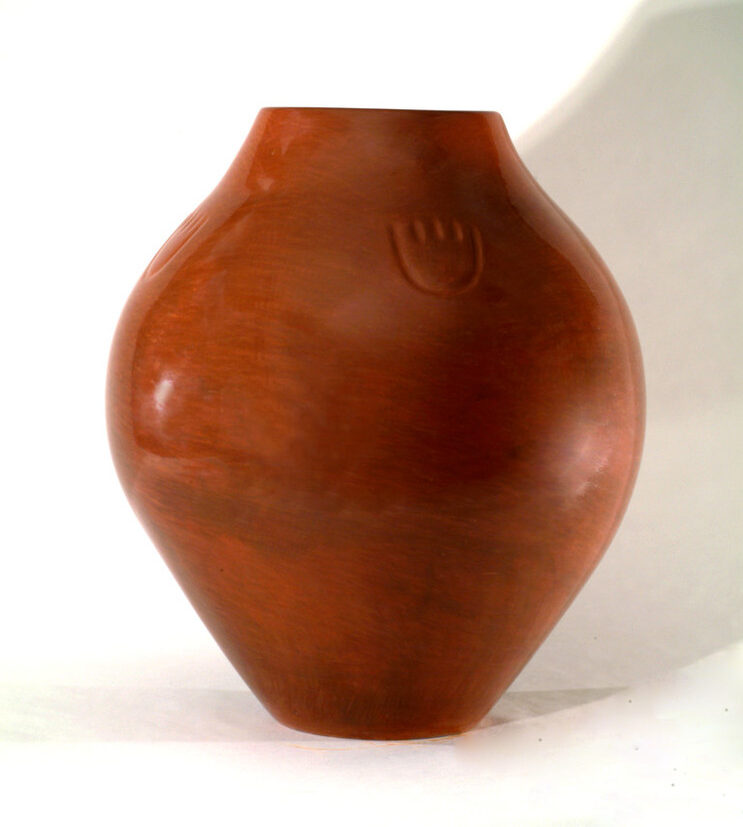
Similarly, the bear-paw imprint represents health, strength, and water, alluding to a Pueblo story in which a bear led people to fresh spring water during a time of drought, thereby saving them. NMWA’s storage jar by LuAnn Tafoya (b. 1938), a classic Santa Clara style with a round shape and short neck, features four bear-paw imprints around the shoulder of the highly polished vessel.
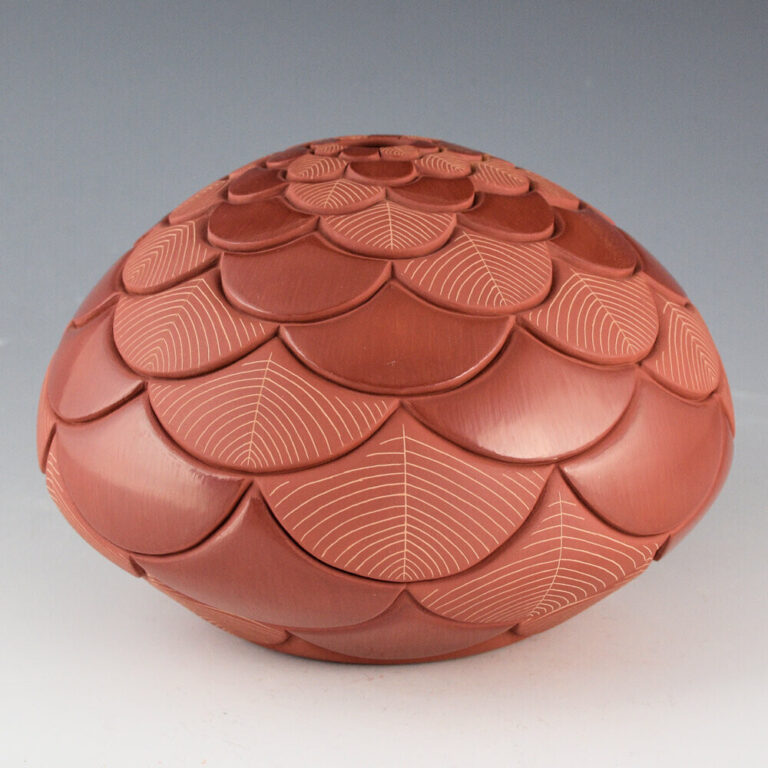
Recent museum acquisitions reflect the practices of younger generations of potters who bridge ancestral teachings with modern creative techniques. The great-granddaughter of Margaret Tafoya, Stephanie Tafoya (b. 1991) combines contemporary design with traditions practiced by generations of potters in the Tafoya family. The clay and pigments are locally sourced and processed by hand, and each vessel is coil-built, coated with slip, stone-polished, and fired to achieve the desired result. Tafoya’s Ember Embrace (2025) takes inspiration from her pet African gray parrot, Beto, as well as the significance of feathers in Pueblo ceremonies and rituals. She carves each feather, then creates contrast by either polishing them to a smooth shine or etching the matte feathers to reveal a different color underneath.
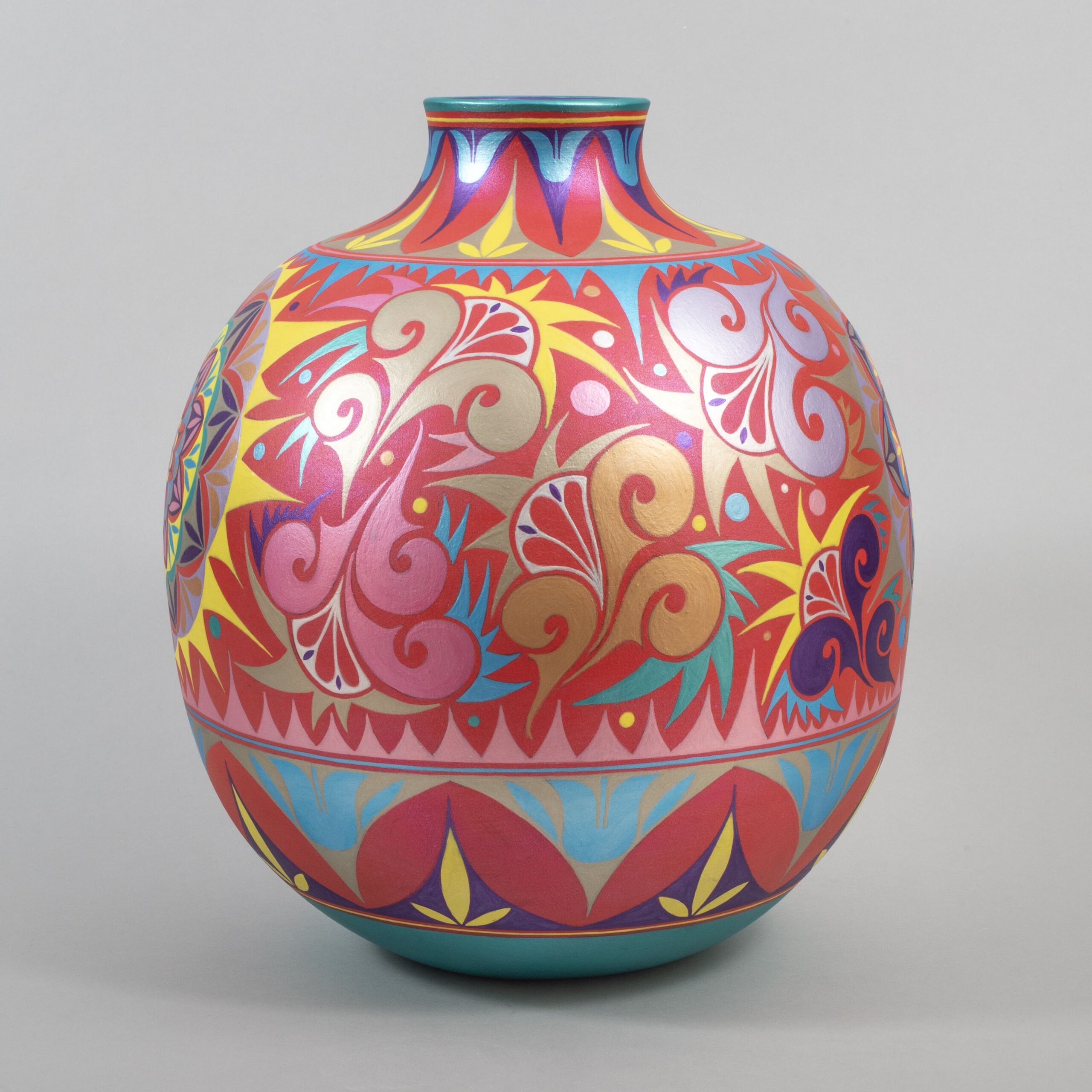
Cochiti potter Lisa Holt (b. 1980) and Santo Domingo (Kewa) artist Harlan Reano (b. 1978) work together on their vibrant acrylic-painted pottery. The artists build on the Cochiti Pueblo visual vocabulary of geometric and linear designs. Repeating step motifs, stylized tulips, swirling forms evoking water, and banded registers reference longstanding systems of order, movement, and cycles of the natural world. Their innovative use of pulsating acrylic pinks, yellows, and blues further evokes the forces of nature.
Legacy
As NMWA approaches its 40th-anniversary year, the works in Burnished reflect the museum’s role as a champion for the ceramic tradition, which began with Wilhelmina and Wallace Holladay and continues today in their family. While Hap Holladay collects a wide variety of art, he says, “My parents taught me to appreciate the beauty in art, and I shall be forever grateful for that gift. I am intrigued by the whimsy, creativity, imagination, and technical skills evident in an artwork’s design, and in the case of Pueblo pottery, the broad range of style and expression.” With their labor-intensive process and deeply meaningful artistic expressions, the works of Pueblo pottery in Burnished reveal the enduring importance of this venerated art form.
Visit Burnished: Pueblo Pottery at NMWA through September 27, 2026.