

Joan Snyder
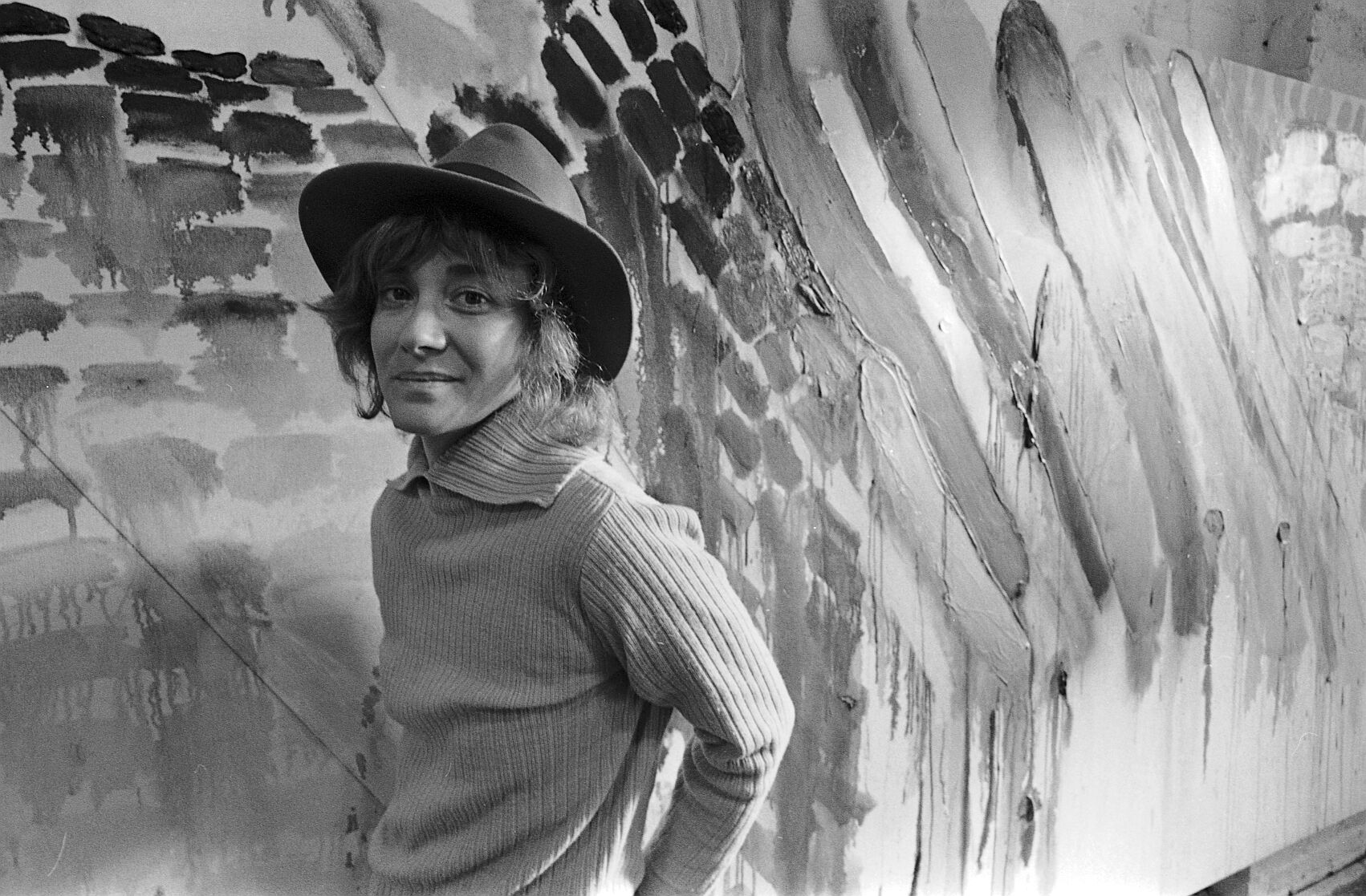
Joan Snyder with Symphony; Photo by Larry Fink, 1971
Joan Snyder was born and raised in Highland Park, New Jersey. She graduated from Rutgers University with an MFA in 1966; the following year, she moved to New York, where she became active in the women’s liberation movement. Since that time, feminism has shaped her art and activism.
Snyder set out to develop a feminine language of abstraction that was expressive, narrative, and autobiographical. Her breakthrough came in 1969 with the “Stroke” series: paintings that feature gestural brushstrokes over a lightly sketched grid. She wrote, “The strokes in my paintings speak of my life and experiences . . . they bleed and cry and struggle to tell my story with marks and colors and lines and shapes. I speak of love and anguish, of fear and mostly of hope.”
In the mid-1970s, upheavals in Snyder’s personal life prompted her to abandon the grid and expand her visual vocabulary. Text, found objects, and allusions to the female body allowed her to process motherhood and her lesbian identity. Since then, painting has offered Snyder the spiritual and emotional catharsis of a religious rite: a means to explore subjects ranging from Judaism to the AIDS crisis.
In 1971, Snyder founded the Mary H. Dana Women Artists Series at Rutgers University, now the oldest continuously active exhibition space dedicated to women artists in the US. She also co-founded the groundbreaking journal Heresies: A Feminist Publication on Art and Politics (1977 to 1993).
Snyder has received numerous accolades in her career, including more than 80 solo exhibitions and fellowships from the National Endowment for the Arts (1974), the John Simon Guggenheim Memorial Foundation (1983), and the MacArthur Foundation (2007).
