


Women played a vital role in shaping the visual culture of the Low Countries, present-day Belgium and the Netherlands, during the 17th and early 18th centuries. Women Artists from Antwerp to Amsterdam, 1600–1750 is the first-ever survey exhibition of women artists from this region and time period. Including more than 40 artists, with many works on view in the United States for the first time, it demonstrates that women were an active and consequential part of one of the most robust and dynamic artistic economies of the era.
Legacy
While many Flemish and Dutch women artists were acclaimed during their lifetimes, they have largely been forgotten or excluded from art history in the intervening centuries. In their essay “Value, Memory, Legacy” in the exhibition’s catalogue, co-curator Virginia Treanor and exhibition assistant Katie Altizer Takata write, “The lack of visibility today of historical women artists and their work stems from a combination of factors including gender bias, canonical bias, and survival bias. A deep-seated and frequently unconscious belief that women artists were just not ‘as good as’ their male peers has contributed to their lack of inclusion in public collections…”.
Works by women artists, such as paintings, paper cuttings, and lace, were highly sought-after during the 17th and 18th centuries, yet they have been disregarded, misidentified, or neglected from art historical scholarship over time. A traditional artistic hierarchy, which holds representational art such as painting and sculpture at the apex, has long excluded mediums in which women were prominent, such as textile works. However, even paintings, drawings, and prints by women have been commonly misattributed to male artists and overlooked for conservation and research.
Righting the Canon
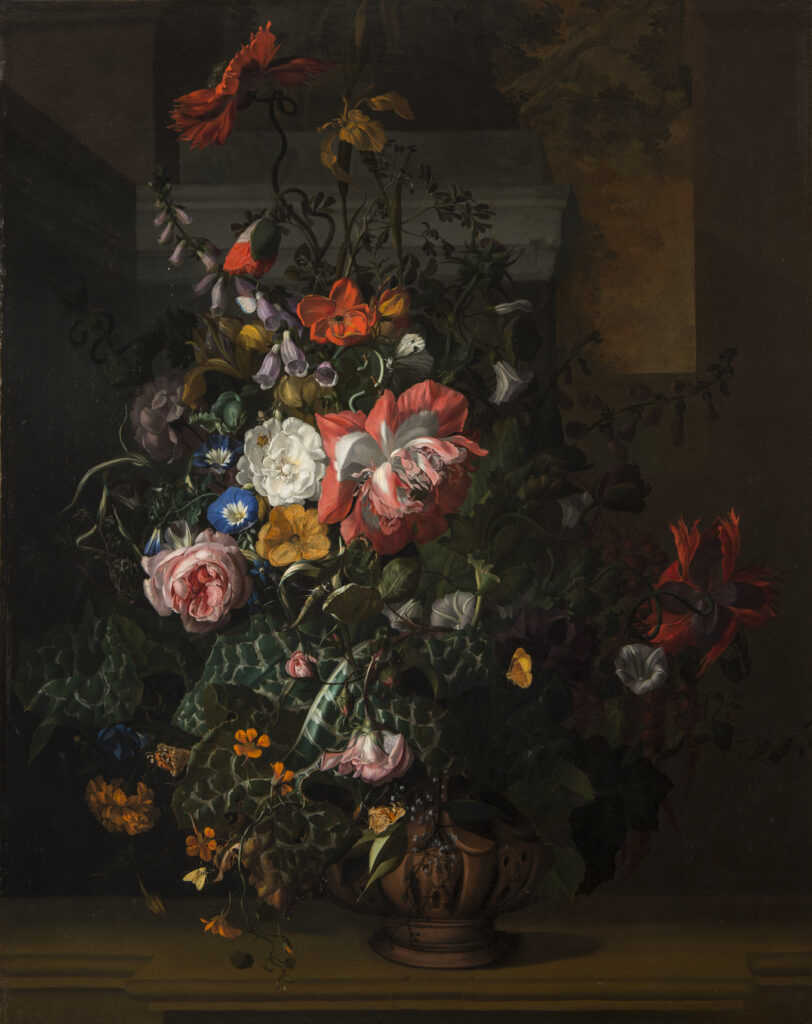
Recent scholarship has bolstered interest in historical women artists within the art market and museums. The first-ever major exhibition devoted to Rachel Ruysch (1664 to 1750) opened in 2024 at the Alte Pinakothek, Munich, with additional U.S. venues in 2025. This is notable because Ruysch never suffered the fate of misattribution or erasure that many women artists did; she was under-recognized only because of gender bias. Similarly, the work of Judith Leyster (1609 to 1660), whose identity was rediscovered more than a century ago, is only now enjoying success at auction, as evidenced by the Currier Museum of Art’s 2022 acquisition of Boy Holding Grapes and a Hat (ca. 1629).
Additional works in this section shed light on forces that have shaped our unbalanced understanding of the period:
Nicolaas Juweel (ca. 1639 to 1704), Watching a Paper-Cut Wind Toy, ca. 1697
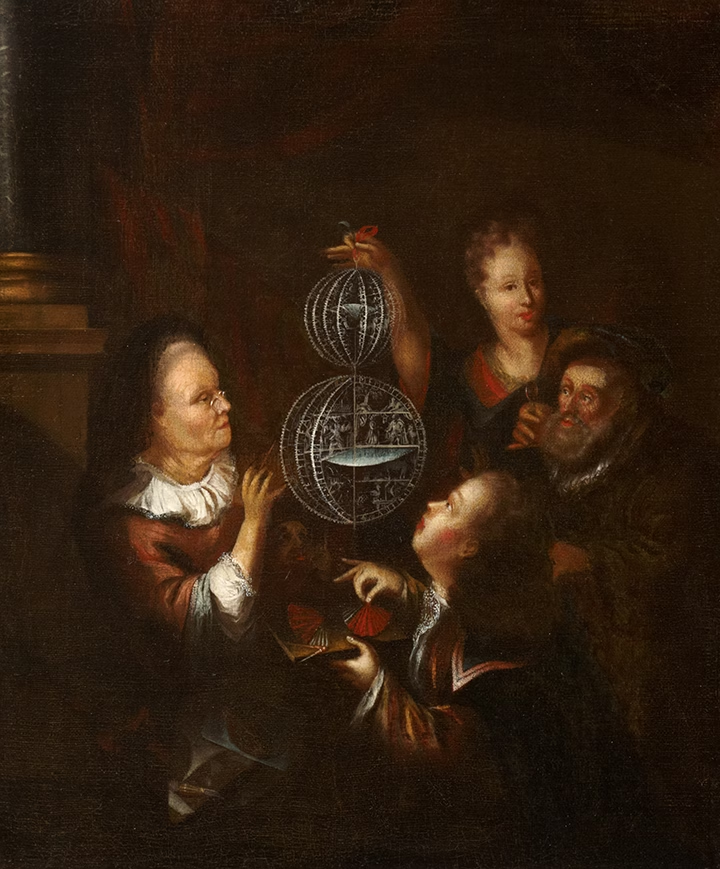
Created by both men and women, paper cuttings were popular and costly art objects of the period. Women artists Johanna Koerten (1650 to 1715), and Elisabeth Rijberg (active 1698 to 1710) were two of the most celebrated paper-cutting artists in the Dutch Republic. Due to the medium’s fragility, as well as its historical exclusion from the canon of “high” art, many examples, such as the three-dimensional work pictured here, have not survived. While the older woman in this painting has not been identified, she may be another paper artist or collector of such works.
Unidentified artist(s), Benediction veil in bobbin lace, ca. 1750-90
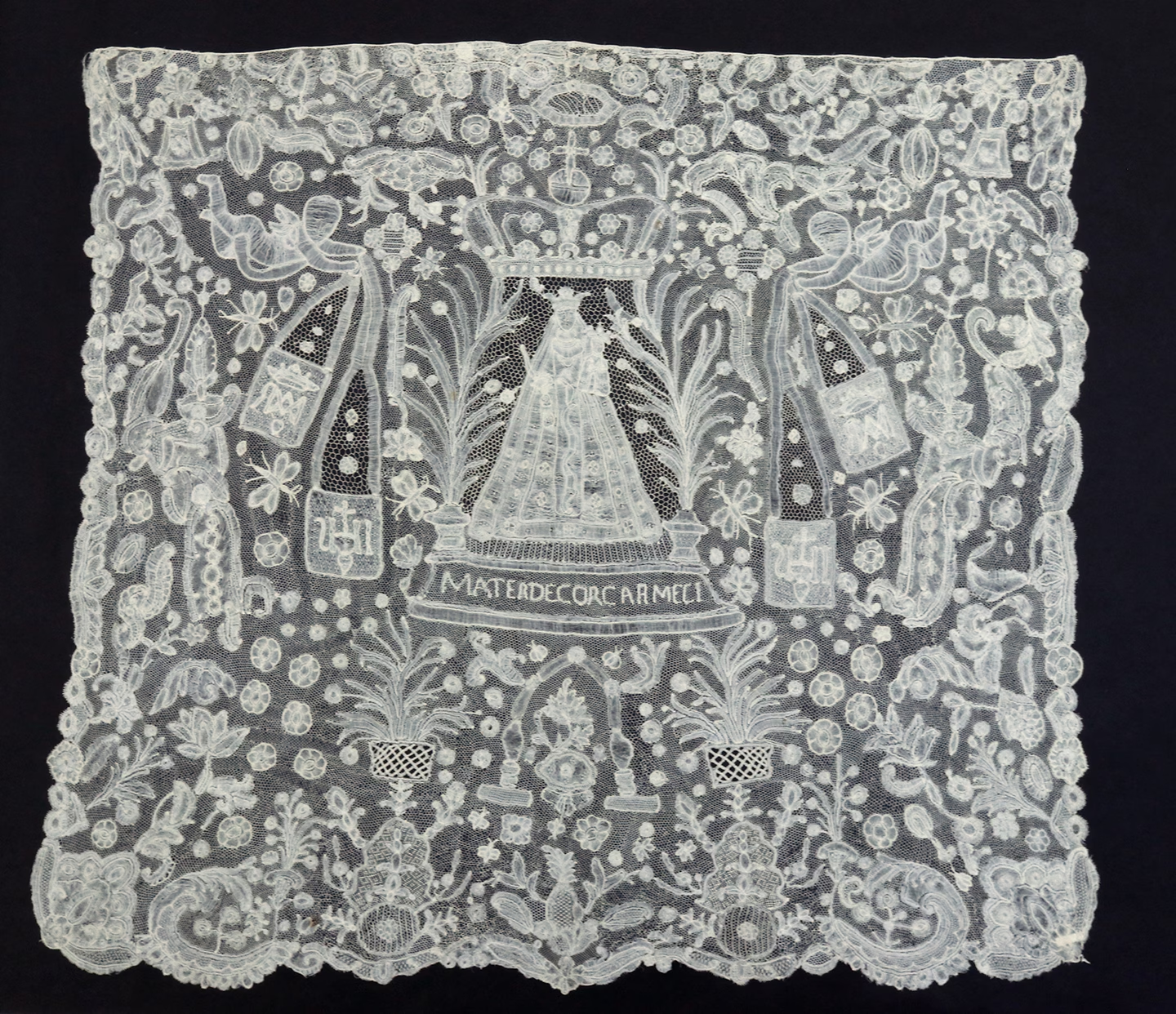
Textiles such as lace, some of the most expensive items to purchase in the 17th and 18th centuries, are, today, often valued less than works such as paintings and their female creators are unknown. This devaluation is evident in their sales prices in the art market as well as their lack of visibility within art historical scholarship and many museum collections. Women can be credited with preserving lace for posterity, too, as they assembled many of the most important lace collections in U.S. museums. Without their efforts, much of the cultural legacy of lacemaking might have been lost.
Catarina Ykens I (1615 to after 1665) or Catarina Ykens II (1659 to after 1689), Portrait of a Woman Playing the Guitar, Surrounded by a Garland of Fruit and Flowers, ca. 1660-80
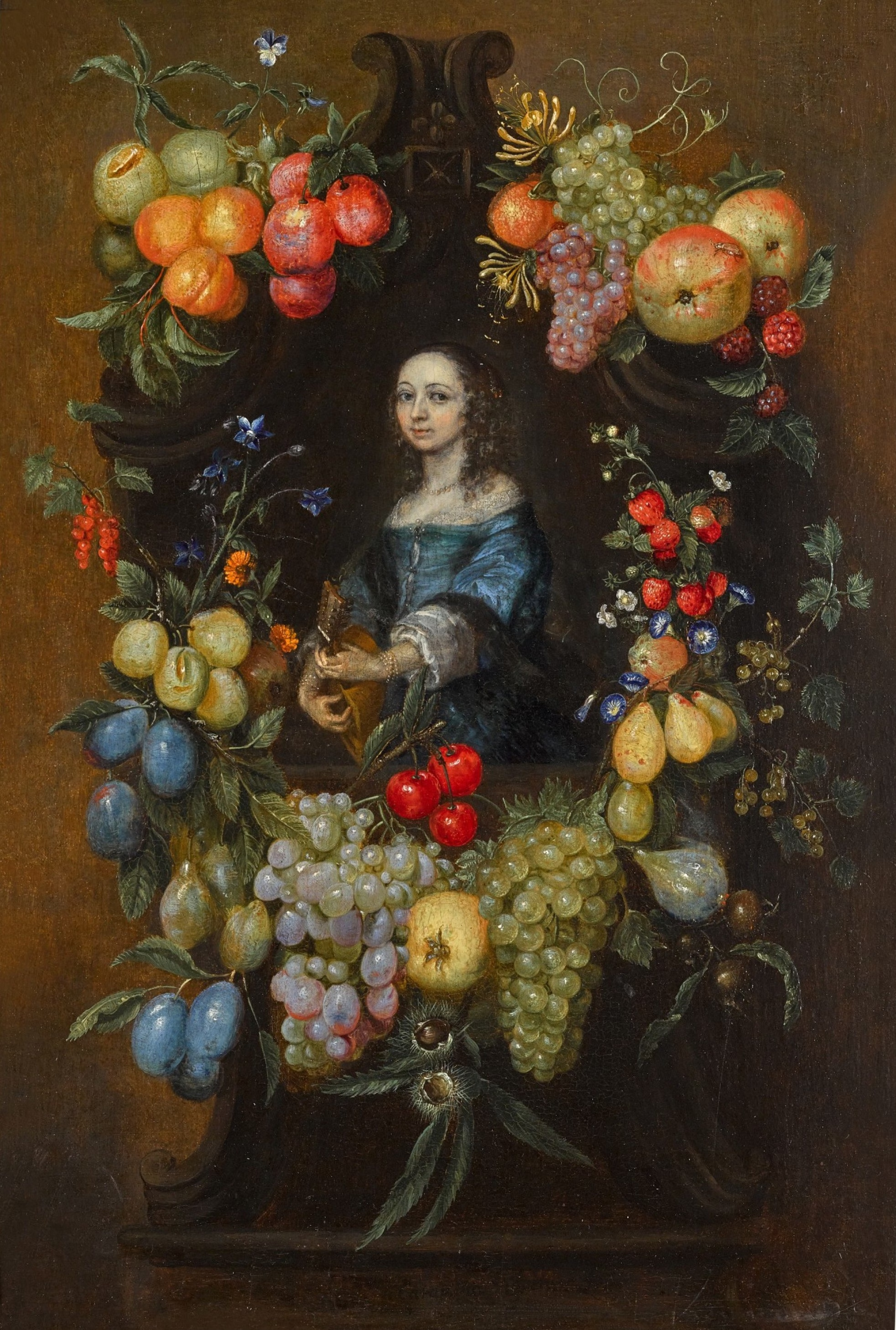
Works by women are becoming more popular to acquire—both by collectors and museums—as individuals and institutions learn about recent research into historical women artists and seek to broaden their collections. This painting has been attributed to both Ykens I and Ykens II, who, in addition to being related and sharing a name, also had similar painting styles. More research into these artists is needed to clarify their respective oeuvres.
Recovering and recognizing Dutch and Flemish women’s artistic contributions provides a fuller appreciation of the past. With this renewed interest, the work of more women is being rediscovered, with many more undoubtedly left to find.
Want to learn more? Visit Women Artists from Antwerp to Amsterdam, 1600-1750, through January 11, 2026, and buy the exhibition catalogue from NMWA’s museum shop.