


Beverly Pepper (1922–2020) recollected that a 1980 visit to Washington, D.C., sparked her passion for creating sculptures and spaces that reflect the deep-rooted spirit of a place. Returning from Washington to her home in Italy, she looked at an ancient Egyptian obelisk in a piazza and thought, “That’s a long way from Egypt, but it still has an overwhelming presence.”
For more than 70 years, Pepper explored new processes in creating sculpture and land art. NMWA’s in-gallery exhibition complements Beverly Pepper: Ten Monumental Sculptures, the current outdoor installation in the New York Avenue Sculpture Corridor. Sited right outside the museum’s front door, this exciting public art initiative was established by NMWA and the DowntownDC Business Improvement District in 2010.
A Fearless Experimenter
After earning a degree from Pratt Institute in her hometown of Brooklyn, New York, Pepper enjoyed a successful design career. In 1949, she relocated to Europe to study painting. Several years later, she turned to sculpture, inspired by a revelatory visit to Angkor Wat in Thailand as well as the medieval cities around her home in central Italy, where she settled in the 1950s.
In 1962, when invited to participate in an exhibition of urban sculpture in Spoleto, Italy, Pepper asked a neighboring blacksmith to teach her how to weld. Her subsequent—and unprecedented—partnerships with factories, engineers, and metal manufacturers marked her abiding interest in materiality and fearless commitment to experimentation.
Her position as one of the first artists to sculpt with weathering steel remains under-studied by historians, as do her achievements in land art, partly because these brawny mediums are conventionally associated with male artists.
Art for the Open Air
Within her abstract sculptures, Pepper combined shape, texture, and scale to cannily evoke the historical essence of a place. Her angular Todi Columns (1979–2021), originally conceived for the central piazza of the Italian hill town where she lived, resemble ancient columns, monuments, or boundary markers. Now on view in the urban landscape of downtown Washington, the towering columns appear as emblems of a capital city in which power and sometimes conflict shape communities far beyond the District of Columbia’s boundaries.
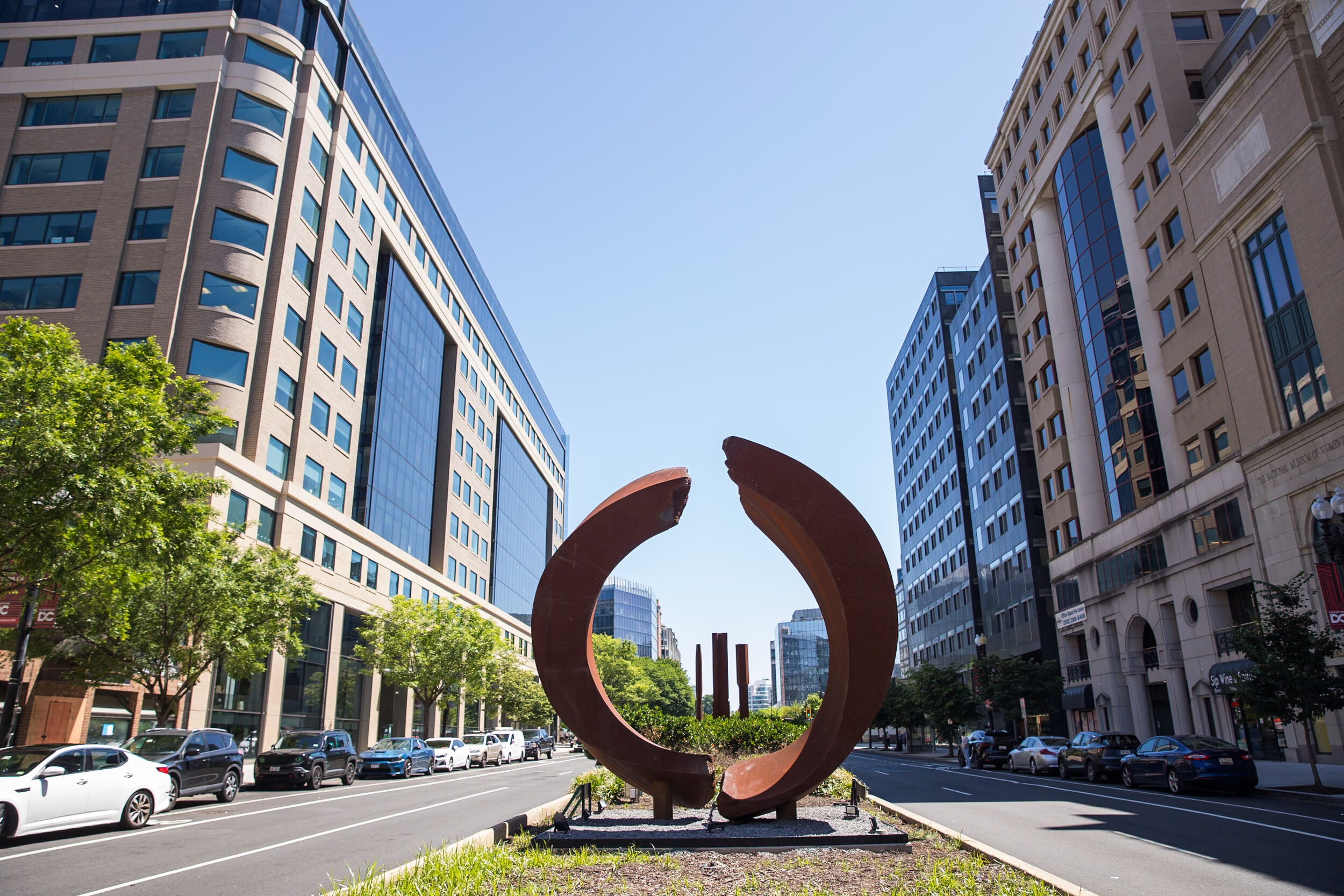
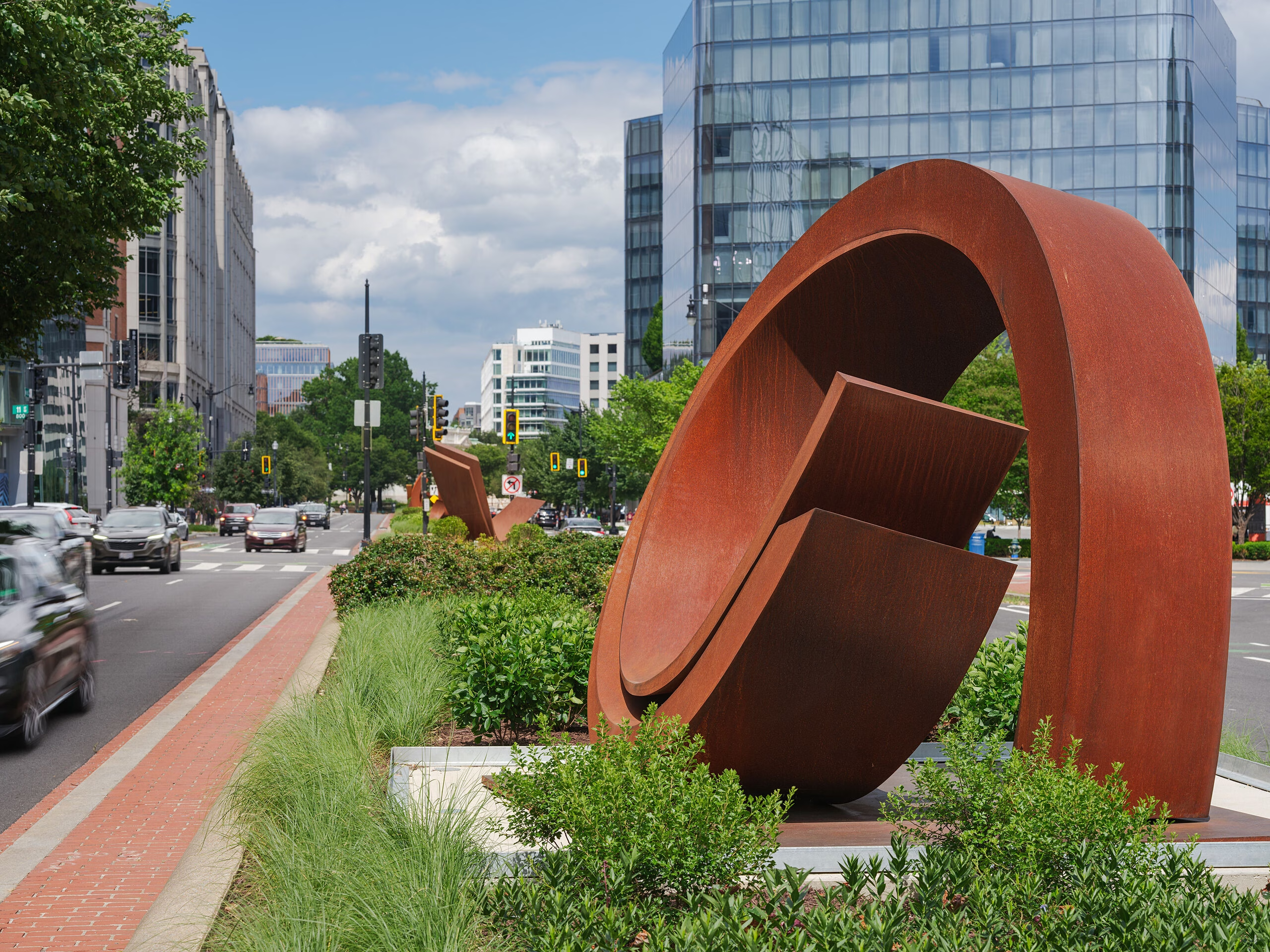
Other large-scale sculptures on view along New York Avenue are circular in form, their curves emphasized by doubled shapes. Although made from thick sheets of steel, each appears stunningly ribbon-like in flexibility. The rolling forms of Broken Circle (2011–25), Curvae in Curvae (2013–18), and Double Palimpsest (cover image, 2012–25) echo the motion of traffic flowing by, although Pepper worked with the circle shape for more soulful reasons. She described how curves create “an inside out space, a space that seems to embed the viewer within the sculpture itself.”
As visitors move past each sculpture in the outdoor installation, the artworks’ twisting shapes appear to widen, lengthen, compress, or rotate with just a few steps taken. The surface of each weathering steel sculpture is covered with a velvety layer of rust, the result of corrosion and oxidation that take place when steel is exposed to the atmosphere. Pepper prized this effect. On sunny days, her rust-coated sculptures glow bright orange. In stormy weather, the works’ wet surfaces appear nearly black.
Art for the Enclosed Space
NMWA’s in-gallery exhibition presents a new film about Pepper by Sierra Pettengill and garden-scale editions of Pepper’s monumental sculptures. Jewel-like versions of My Circle (2008/2023), Medea, variation 2 (2015), and Nuova Twist (2008), which each have related counterparts out on New York Avenue, twist and turn with intense but contained energy.
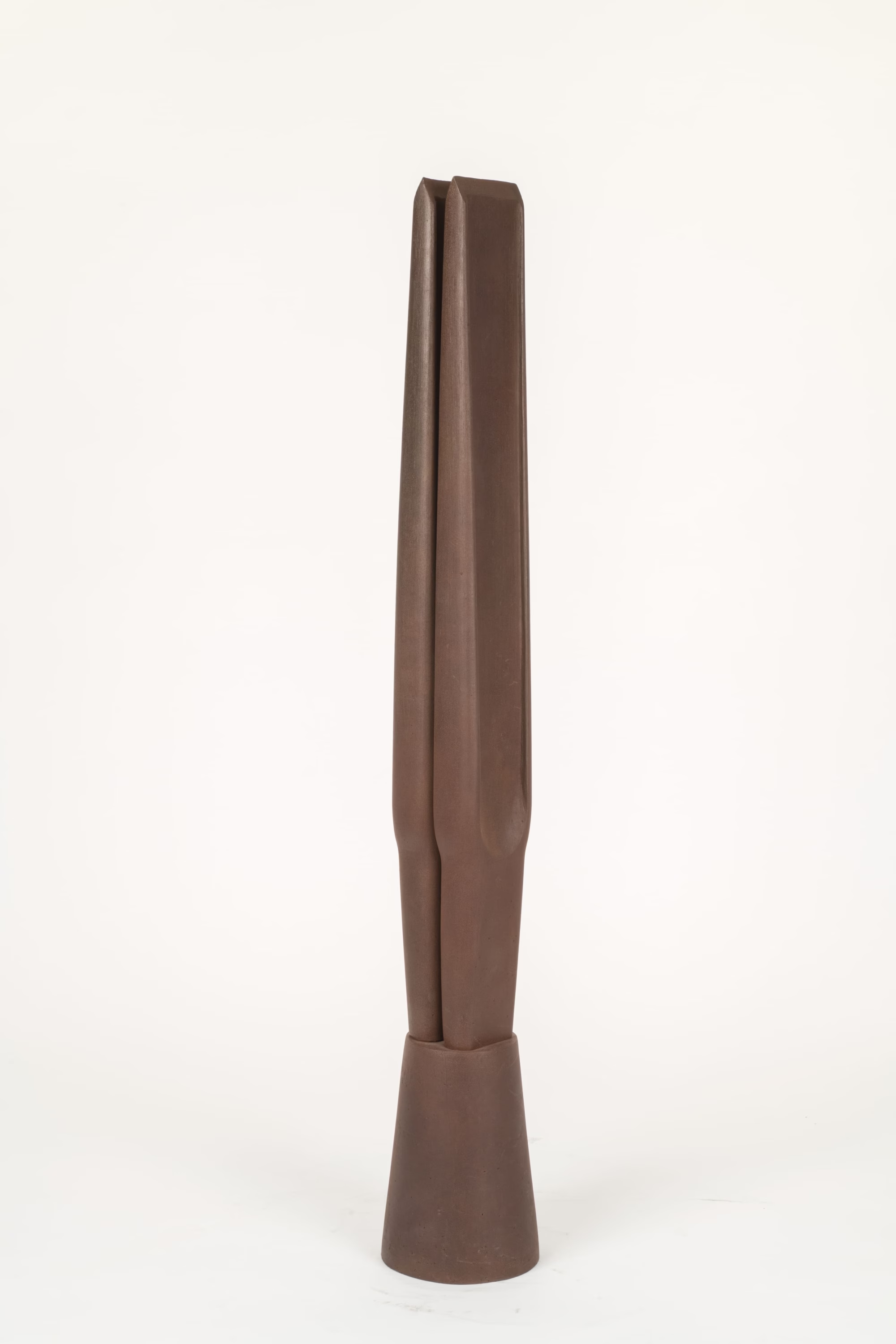
A cast iron sculpture from NMWA’s collection demonstrates Pepper’s exploration of evocative totemic shapes earlier in her career. With a smooth, red-brown patina, the untitled sculpture resembles a pair of sanding files. Pepper made numerous works evoking the tools of her sculpting practice. “They’re an extension of my hands,” she said. “I simply began to transfigure them…. Standing up, you’ll find they take on a life of their own.”
Homecoming
At the time Pepper made her momentous visit to Washington, D.C., she exhibited her Todi Columns in the city as part of an international sculpture conference held just a few blocks from NMWA’s building. In its 40th-anniversary year, the museum is thrilled to welcome Pepper’s public works back to the nation’s capital and share anew the story of their powerfully inventive and poetic creator.
Visit Beverly Pepper: Land Art and Monumental Sculptures through April 25, 2027.