

My biggest challenge while performing research for NMWA’s new spring exhibition, Pomp and Power: Antoinette Bouzonnet Stella’s “Entrance of the Emperor Sigismond into Mantua” was grappling with the fact that so little information has been published about the artist, French printmaker Antoinette Bouzonnet Stella (1641 to 1676). Like many women artists, her history has been obscured over the centuries, fragmentarily preserved in footnotes and forgotten documents. Fortunately, there was a way around this debacle: with no access to formal art school, Antoinette was trained by her uncle, Jacques Stella, a prominent painter, printmaker, and court artist to Cardinal Richelieu in Paris. Much more well-known than his niece, Jacques Stella served as the first focal point of my research. By studying his life and work, I was able to construct a context for the career of Antoinette Bouzonnet Stella.
A friend and colleague of Nicolas Poussin (1594 to 1665), Jacques came to prominence in the 1630s, a period when the appearance of ancient Greek and Roman art gained popularity over the flamboyant, theatrical style of the sixteenth century. Jacques studied ancient Roman sculpture first-hand in Italy and reproduced its weighty, idealized forms in his paintings and prints. In 1636 he became court artist to Cardinal Richelieu, chief minister to Lois XIII, who commissioned Jacques to create public art that embodied the lofty political, militaristic, and intellectual connotations of Classical antiquity. Jacques enjoyed success under Richelieu and was awarded prestigious lodgings in the Louvre.
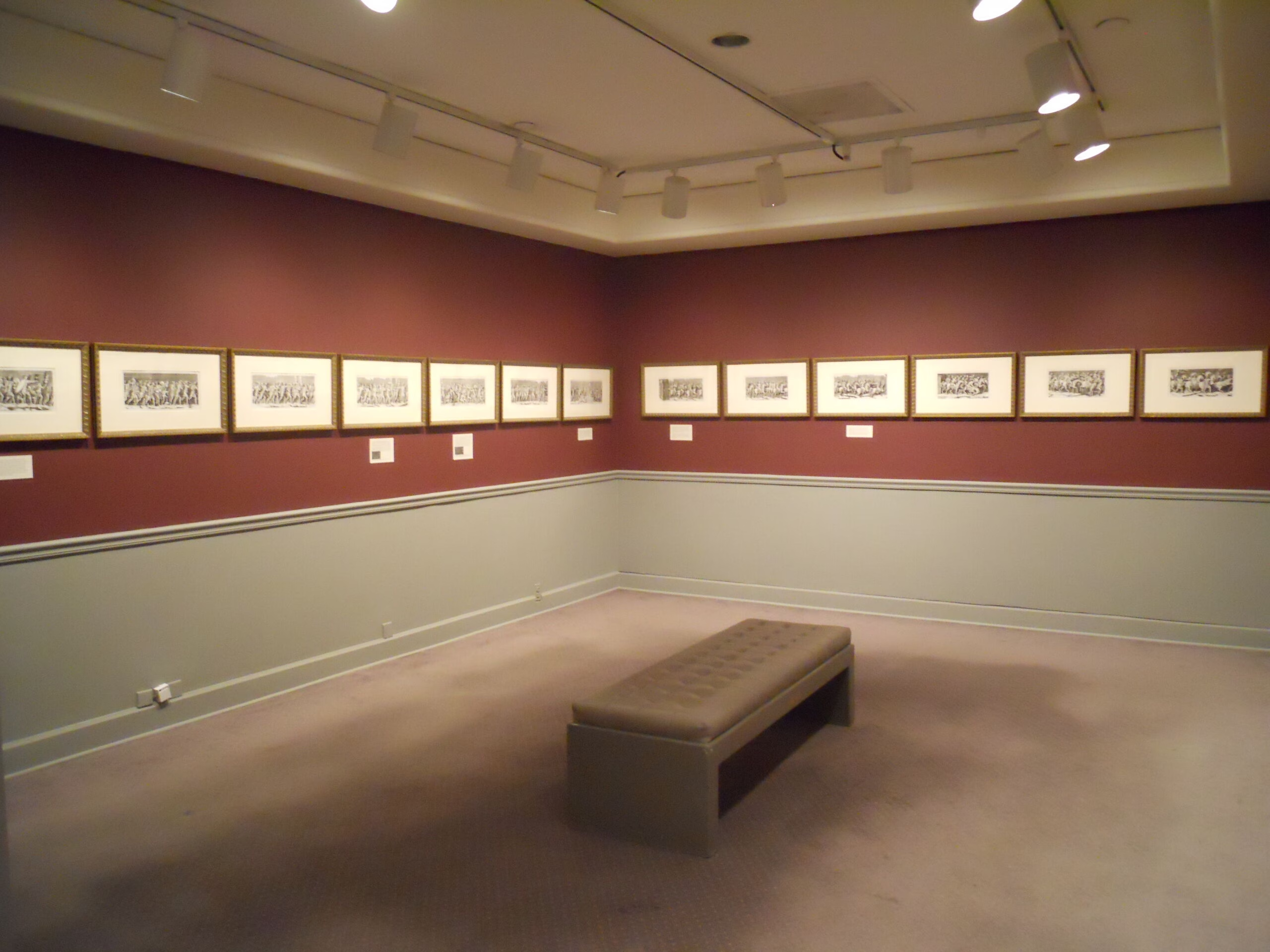
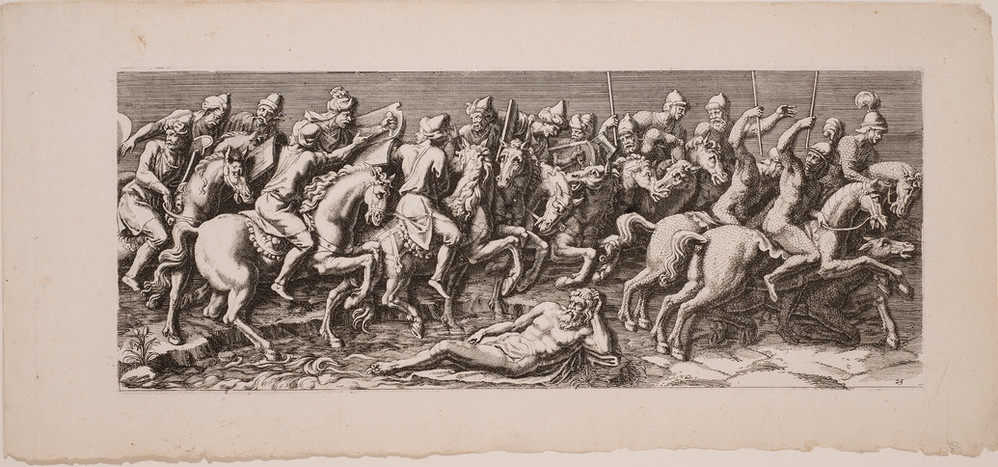
At age thirteen, Antoinette and her siblings moved to the Louvre at their uncle’s invitation. There, she mastered various techniques of printmaking and collaborated with her sisters in copying paintings by their uncle and Poussin. Antoinette also received her own commissions: in 1675, she executed The Entrance of the Emperor Sigismond into Mantua, a series of twenty-five engravings for Louis XIV’s minister of finance. NMWA is fortunate to have a complete set of these engravings, which from left to right replicate a stucco frieze that wraps around the Sala degli Stucchi (Room of the Stuccos) of the Palazzo del Te in Mantua, Italy.
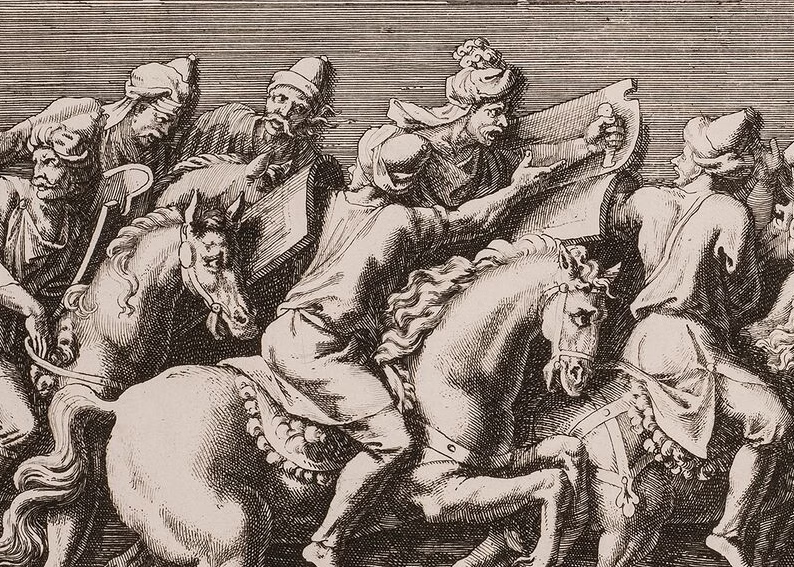
Created a century before Antoinette’s lifetime by Italian Renaissance artists Giulio Romano (1499–1546), a pupil of Raphael’s, and Francesco Primaticcio (1504 to 1570), the frieze in Mantua narrates a crucial event in Mantua’s history: in 1433, Holy Roman Emperor Sigismond visited the city and bestowed the title of marquis on Gianfrancesco I Gonzaga. The frieze aggrandizes Sigismond’s visit by portraying him at the center of a Roman adventus, or triumphal entrance into a city. Sigismond, dressed in the armor of Rome, enters Mantua flanked by soldiers, musicians, river gods, sacrificial animals, slaves, and spoils of war.
Brilliantly executed, Antoinette’s Entrance of the Emperor Sigismond into Mantua exemplifies the power of a narrative borrowed from antiquity, employed in sixteenth-century Italy, and later appropriated by the French court.
Pomp and Power: Antoinette Bouzonnet Stella’s “Entrance of the Emperor Sigismond into Mantua” was on view through August 22, 2010, in NMWA’s Teresa Lozano Long Gallery.