


Visionary artist Marlo Pascual (b. 1972, Nashville; d. 2020, Philadelphia) created works that amuse, confuse, and provoke by dramatically recontextualizing anonymous vintage photographs and found objects. The artist transformed her thrift-store source material through enlargement, fragmentation, obfuscation, and the addition of external elements: These strategies upend viewers’ initial reactions of nostalgia or familiarity.
Marlo Pascual: Making Something Out of Something, on view through February 28, 2027, presents 17 of Pascual’s works from between 2009 and 2014, demonstrating her remarkable legacy.
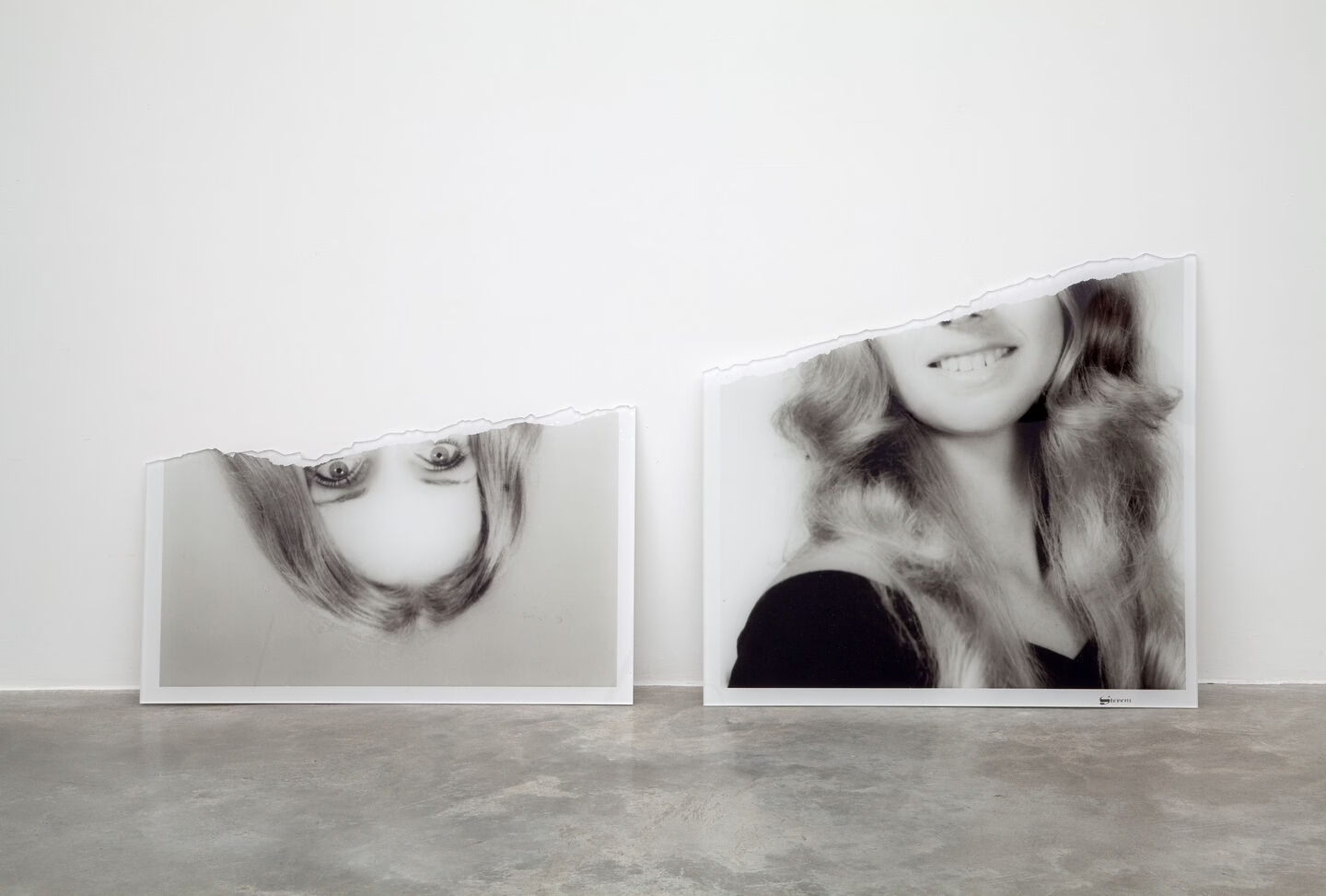
Piecing It Together
Pascual, who was born in Tennessee, obtained her MFA from the Tyler School of Art, in Philadelphia, in 2007. Although she had applied to study photography, her approach to the medium shifted when she experimented with pouring paint over a photograph. This began Pascual’s practice of manipulating found images, creating works that blur the boundaries between photography and sculpture.
Pascual spoke of choosing source imagery that she felt was “overtly constructed,” such as vintage studio portraits, yearbook photos, and advertisements. She saw these images as fragments in and of themselves: “I think about the construction of the image, how it’s a fragment, and not the whole story, not the truth with a capital ‘T.’” In a work from 2010, Pascual physically fractured one of these fragmentary images, a portrait of a smiling blond woman, by tearing it in half. The result visually reinforces and emphasizes the enigmatic nature of the image.
Changing the Subject
Through her interventions, Pascual exaggerated the inherent artifice of her found imagery. Frequently encasing the enlarged images in thick Plexiglas and pairing them with common yet unexpected objects, Pascual gave them new life and a newly charged aesthetic function. By enlarging them to a scale commensurate with furniture or sculpture, she asserted the physicality of the images. Whether presenting these pictures on their own, as in an image of a suited leg with dress shoe, or with added objects, such as wooden planks that connect to a picture of a pointing finger, Pascual imbued the two-dimensional with volume and form. During a time when social media use was expanding rapidly, Pascual insisted on physical interaction. Her creations stand in stark contrast to the intangibility of digital images.
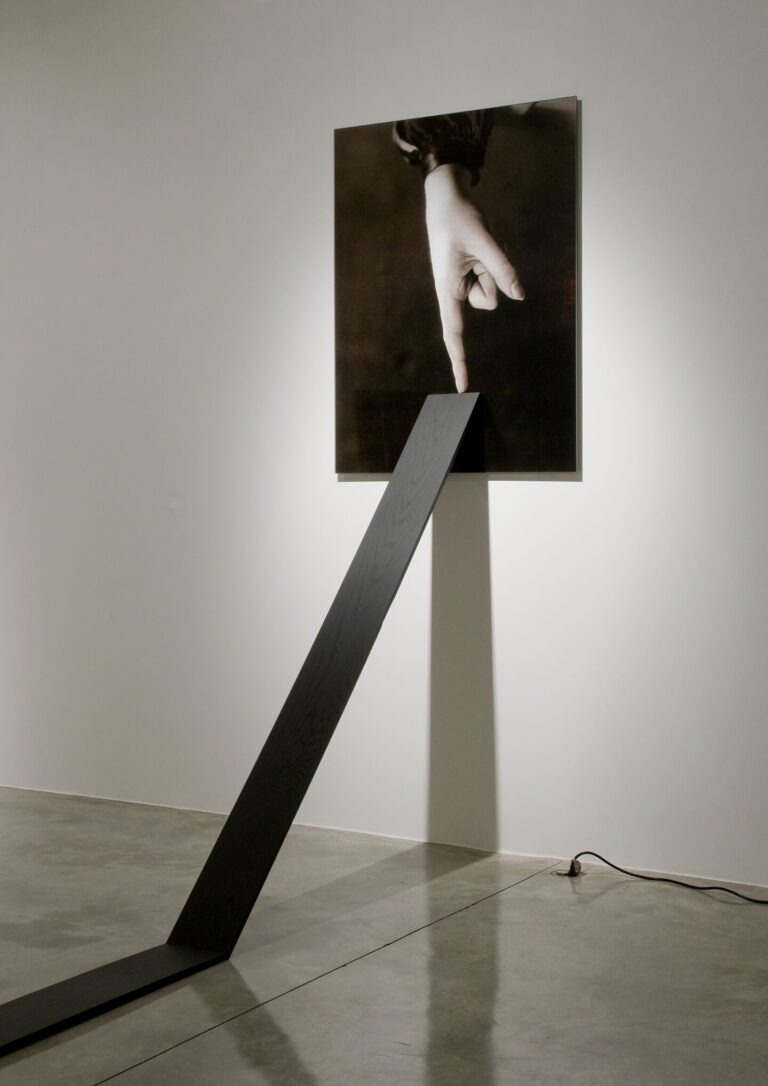
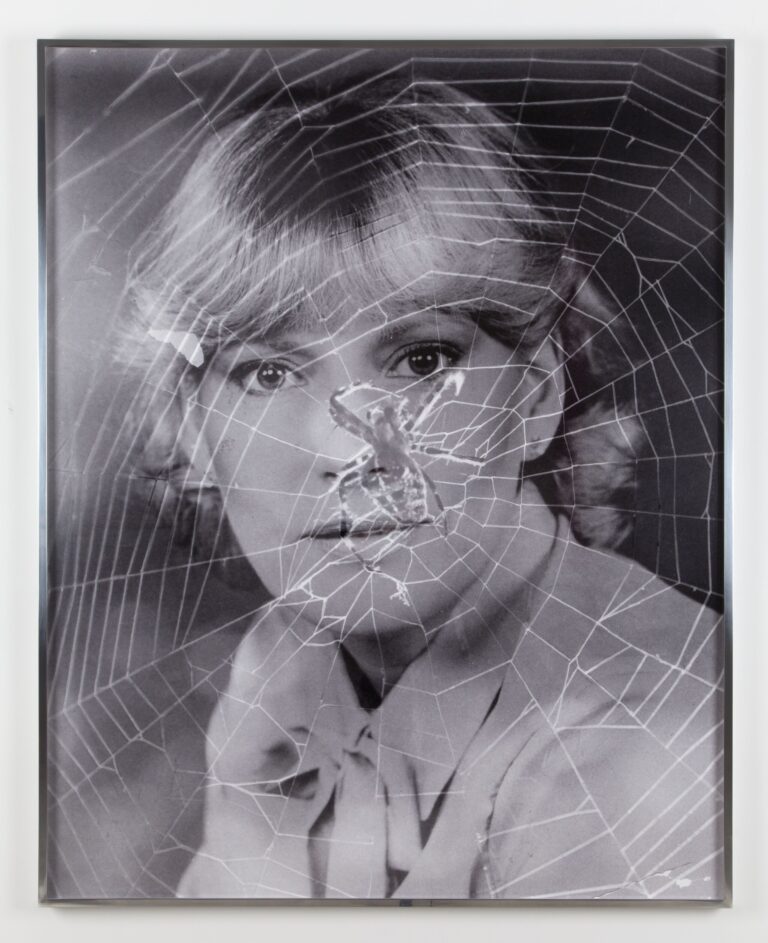
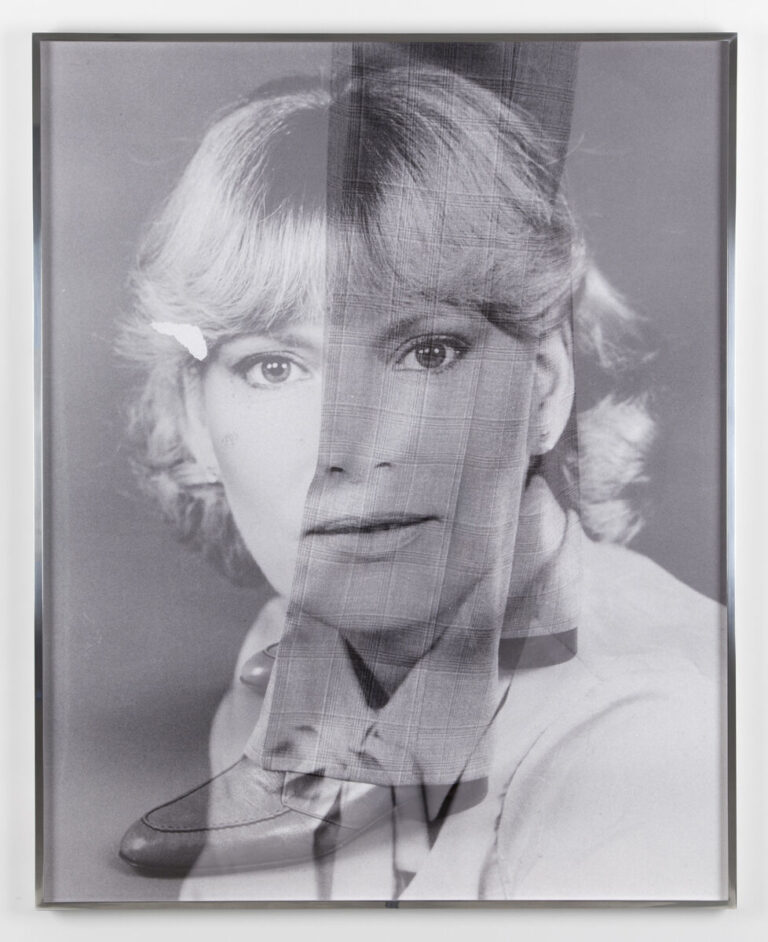
Pascual’s use of found imagery places her in the tradition of the “Pictures” generation, who, beginning in the 1970s, used pre-existing imagery from popular culture or advertising. Artists including Barbara Kruger (b. 1945), Sherrie Levine (b. 1947), and Cindy Sherman (b. 1954) created works whose meaning takes shape in the space between the original context of the images and the artists’ interventions. Similarly, Pascual’s work transforms what is familiar, what might even evoke nostalgia, into something uncanny, prompting deeper contemplation. While this transformation can be humorous, there is also an implied discomfort in the abrupt cropping of limbs, faces obscured by objects, or physical destruction of images by shattering, tearing, or folding. In a series from 2013, the same woman’s head is featured repeatedly; in each work, additional translucent images appear layered atop her face, ranging from the leg of someone wearing a suit and dress shoe to a menacing spiderweb. Whether intended as humorous or sinister, these incongruous elements call attention to the artist’s manipulation and, by extension, the artifice of the original image.
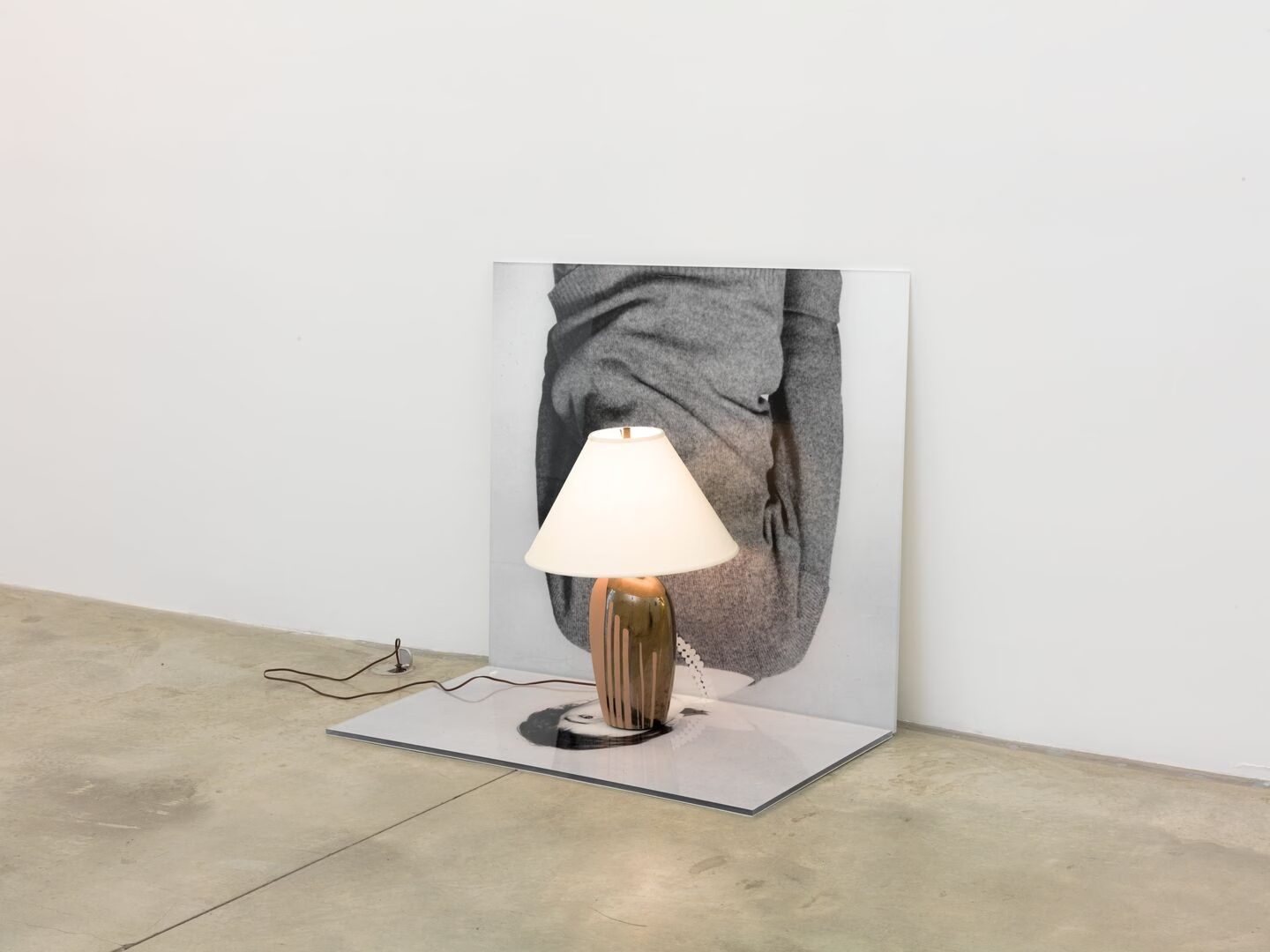
Many artists have presented fragmented bodies in their work, but this stylistic and conceptual device has been especially effective in the oeuvres of women artists such as Louise Bourgeois (1911–2010) and Wangechi Mutu (b. 1972), who both circumvent and highlight the hypersexualization of the female form in art history and popular culture. As many of Pascual’s fragmentary images depict women, her works can also be seen as commentary on the objectification of women. Furthermore, the transformation of the images into large, stationary objects, often juxtaposed with or attached to domestic objects such as lamps or candleholders, seems to bring the absurdity of “woman as object” to its inevitable, irrational conclusion. In a work from 2017, Pascual flipped a bust-length portrait of a woman upside down and positioned the head and neck at a 90-degree angle beside the torso. She then placed a table lamp directly on top of the woman’s face, obscuring it completely. In this way, the portrait of the woman becomes the physical support for this common household item, relegating her to the same inanimate status.
More Than the Sum of Its Parts
Pascual’s deceptively minimalist approach to her works belies the complex questions they elicit. Where this practice might have led her is, unfortunately, unknowable due to her early death from cancer at the age of 48 in 2020. Despite her short career, Pascual’s body of work is a powerful testament to her skill and vision, ensuring that the legacy of this prescient and thought-provoking artist will endure.
Visit Marlo Pascual: Making Something Out of Something through February 28, 2027.