

Instructional Objectives
Visual Arts
Students will:
- Understand and engage in the process of art criticism: describing, analyzing, interpreting, and evaluating.
- Draw parallels between the creative processes of professional artists and their own.
- Be able to name three abstract artists and identify characteristics of their work.
- Visually express inspiration and personal voice within a single work of art.
Writing
Students will:
- Understand and engage in the process of art criticism: describing, analyzing, interpreting, and evaluating.
- Understand that an artist must be able to clearly articulate her/his ideas in writing throughout the creative process, from initial proposal to final reflection.
- Engage in reflective practice and critiques through writing.
Featured Artworks
Instructional Plan
Observe
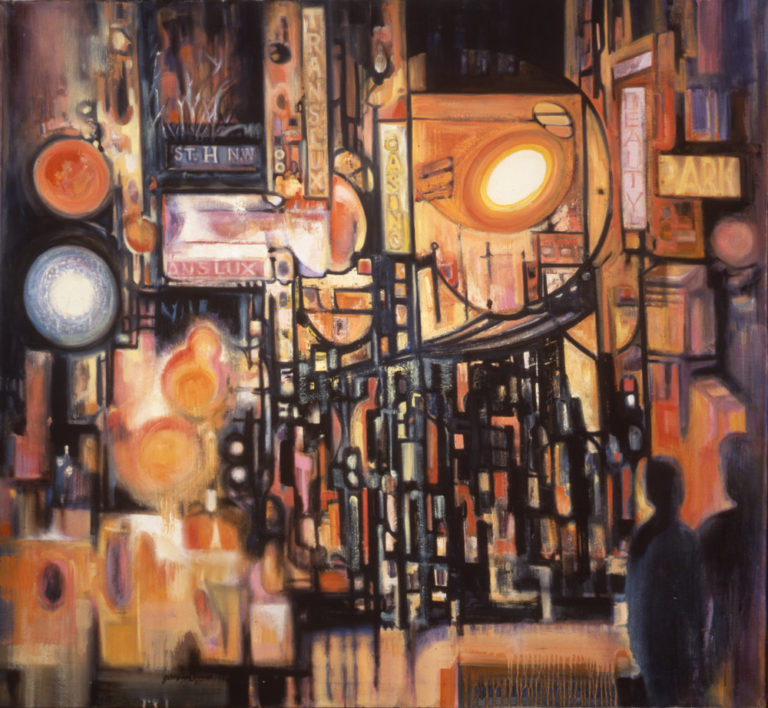
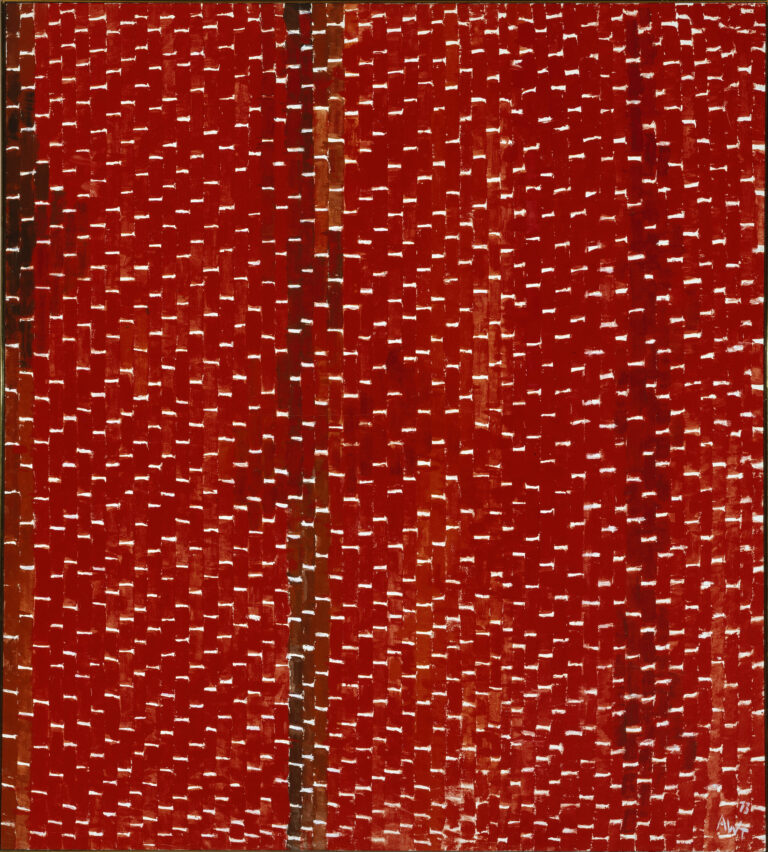
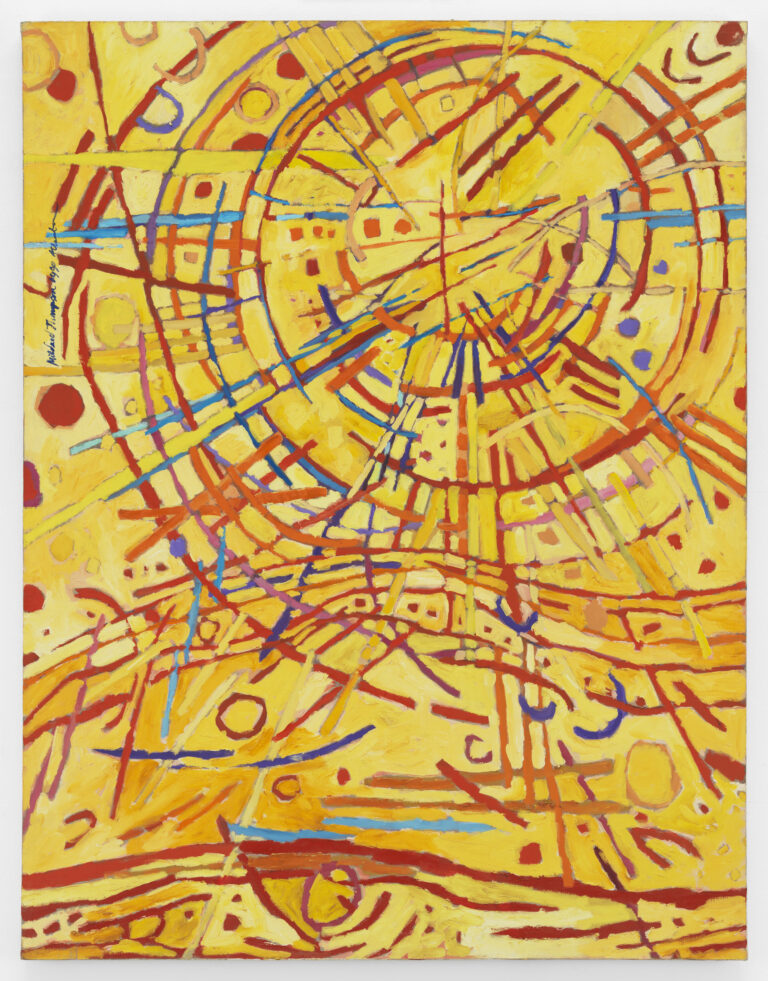
The teacher will present an introduction to abstraction and abstract art, including biographies of Georgia Mills Jessup (1926 to 2016), Alma Woodsey Thomas (1891 to 1978), and Mildred Thompson (1936 to 2003), three women artists featured in NMWA’s collection. Students will take notes in their sketchbooks and create visual journal pages for the three artists.
For the following activities, break up into three groups to divide up the featured artworks, Jessup’s Rainy Night, Downtown (1969), Thomas’s Orion (1973), and Thompson’s Magnetic Fields (1990), among students.


Describe

Imagine you are writing a postcard about this artwork to someone who can’t see it. In 200 words or fewer, describe in detail what you see. Use the Word Bank provided and your past knowledge of art terms to write about the artwork, but don’t mention artist’s name or artwork title. Consider answering the following questions in your postcard:
- What do you see?
- What do you think about what you see?
- What do you wonder?
Students will pair up to share their writing and will be asked to guess which artwork their classmate described.
Analyze

Analyze the artwork for aesthetic/formal concerns. Identify principles of design and elements of art. Using your knowledge of color theory, analyze the artist’s use of color. Consider composition and analyze concerns like arrangement, overlapping, cropping, and balance. Students will share writing in discussion.
Interpret

What clues does the artist provide, visual or verbal (e.g., title), that this work was inspired by the world around her? What might be the subject of this work and what story is the artist telling us about it? When asked, be able to offer evidence, from the artwork and about the artist, to substantiate your inferences. Students will share writing in discussion.
Create: Abstract Artwork
Supplies:
- Sketchbook
- Pen
- Pencil
- Paper
- Self-selected art-making materials
Activity
- Write a proposal for your art project that is inspired by one of the three artists introduced in this lesson by answering the following prompts: Identify the artist and title of the artwork that has inspired you. What about this artist inspired you? What will your artwork be about? Write a brief description of the theme/concept/big idea that is the basis of your art. Thinking of the artist who inspires you, describe your work method. What materials will you use? What techniques will you employ? Given the opportunity, what two questions would you ask the artist who inspires you?
What research will you do to inspire your artwork? What planning will you do to ensure that your artwork is successful and creative? - Once your proposal is approved, planning begins. Jessup, Thompson, and Thomas planned their compositions carefully before putting paint to canvas. Adopting this process, use your sketchbook to plan your composition and your color palette. Include thumbnail sketches, color mixing experiments, and detail sketches.
- Create your final work of art and present it for group critique.
Reflect
Describe what you gained from the experience of working in another artist’s style. Using the Word Bank provided and your past knowledge of art terms, describe, analyze, and interpret a classmate’s completed artwork.
Word Bank
- Balance
Asymmetrical, Radial, Symmetrical
- Contrast
Expressive, Hue, Intensity, Intermediate/Tertiary, Monochromatic, Neutral, Primary, Realistic/Local, Recede, Secondary, Shades, Spectrum, Tints, Warm
- Line
Broken, Continuous, Contour, Crosshatching, Curved, Descriptive, Diagonal, Expressive, Gestural, Hatching, Horizontal, Implied, Outline, Parallel, Perpendicular,, Stippling, Straight, Thick, Thin, Vertical
- Color
Advance, Analogous, Complementary, Cool
- Pattern
Density
- Shape
Geometric, Organic, Negative, Positive
- Space
Cropping, Depth, Flat, Framing
- Texture
Actual, Implied, Negative, Overlapping, Positive, Light, Range, Shading
Credits
Faylinda Kodis, high school art teacher, H-B Woodlawn Secondary Program, Arlington, Virginia, in collaboration with Adrienne L. Gayoso, senior educator, NMWA, in conjunction with the exhibition Magnetic Fields: Expanding American Abstraction, 1960s to Today (October 13, 2017, to January 21, 2018).